KEY TAKEAWAYS
- A quote on the same day means they quoted what you sent without asking what the application needs. That speed is not a good sign.
- The most important question: do they engineer the cable in-house, or do they source it from outside? The answer determines who owns the full engineering picture.
- Ask who you call with a question six months from now. The answer tells you everything about how the relationship will actually work.
- Two-vendor programs put interface risk on the engineer managing them. When cable and assembly are built by different suppliers, neither owns the gap between them.
- Quality on the first article is not proof of production consistency. Ask how the validated design transfers to the production floor and what in-process checks run on every batch.
- Incoming material verification is where most batch-four problems start. Ask what happens when a material conforms to the PO but differs from the assembly spec.
The first assembly supplier you talk to will probably send you a quote the same day. That speed is not a signal of capability. It means they quoted what you sent without asking what the application actually needs.
Mercury Wire has been engineering and manufacturing for OEMs in Spencer, MA since 1967. The questions that predict whether an assembly supplier relationship succeeds rarely appear on an RFQ. They are the ones that separate a partner from a vendor, and you should be asking them before you issue one.
This is a practical guide to evaluating cable assembly manufacturers, written for design engineers and engineering managers who need a supplier that performs consistently across the full life of a production program, not just on the first article.
Do They Engineer the Cable, or Do They Just Assemble It?
The single most important question to ask a cable assembly manufacturer is whether they produce the cable in-house or source it from an outside supplier.
Most assembly houses do not manufacture cable. They receive cable from a vendor they had no input on designing and assemble it to a drawing. The result is an assembly where no single supplier owns the full engineering picture.
The cable was built to a specification. The assembly was built to a drawing. The interface between them covers connector-to-cable geometry, overmold design relative to jacket material, and flex performance across the full assembled length. None of it was designed by either supplier in full context.
When the cable and assembly are engineered together, by the same team, those decisions are made as a system. The connector interface is designed around the actual cable construction. The overmold geometry accounts for the cable’s mechanical properties. The assembly’s flex performance is evaluated against the complete design, not the cable and termination separately.
For applications where the cable construction affects how the assembly performs, and in most demanding applications it does, a supplier that engineers cable and assembly under one roof is a structurally different kind of partner than one that does not.
Will You Actually Talk to the Engineers Building Your Product?
The most predictive signal of a supplier’s engineering capability is whether you speak directly with the engineers doing the work or with a sales or customer service layer relaying information to them.
This matters for a reason that is easy to underestimate before it becomes a problem. Design changes, application questions, incoming inspection questions, prototype feedback, and field failure investigations all require rapid, accurate information exchange between someone who knows the application and someone who knows the assembly. When a sales or customer service layer sits between those two people, every exchange is slower, more prone to miscommunication, and less likely to surface the design context that resolves the issue.
Ask the supplier a direct question: “If I have a question about my assembly design six months from now, who do I call?” The answer tells you how the relationship will actually work.
A supplier who gives you a direct engineering contact is organized to solve problems. A supplier who directs you to customer service or a support ticket system is organized around fulfillment, not engineering partnership. See how Mercury Wire structures direct engineer access.
What Does Their Prototype Process Actually Look Like?
A cable assembly manufacturer’s prototype capability reflects their manufacturing structure, not just their machine capacity.
Suppliers who source cable from outside must coordinate material delivery from a cable vendor before they can build a prototype. That step adds time, introduces a communication dependency, and means the prototype is built from cable that may not reflect the final production specification. When a revision is needed, the cycle repeats.
Suppliers who produce the cable in-house build the prototype from the actual production material. Revisions happen at the manufacturer’s pace, not at the pace of a material supplier. For programs where prototype iteration is part of the design process, and most engineered assembly programs involve at least one revision, that difference in structure is a real difference in speed.
Ask specifically: How long does a prototype take from receipt of specifications? What happens if we need a revision? Who makes the revision decision? Concrete, specific answers reflect real experience. Vague answers about “typical lead times” reflect uncertainty about the process.
At Mercury Wire, assembly-only prototypes are typically ready within 21 days. Programs that require us to engineer and produce the cable as part of the prototype run 6 to 7 weeks. Because we produce the cable in-house, revisions are decided by the same engineers who built the original, and they move at our pace, not a vendor’s.
How Do They Ensure Quality Consistency Across Batches?
Quality problems that appear on the third or fourth production shipment, not on the first article, are almost always a process discipline failure.
First articles receive extra attention. Every supplier builds a good first article. The question is how that validated design is transferred into a repeatable production process and maintained across successive orders. The answer reveals whether a supplier has real production discipline or just good prototype capability.
Ask these questions specifically:
How is the validated design documented and translated to the production floor? What in-process quality checkpoints run during assembly? What happens when an incoming inspection reject occurs: what root cause process runs, and what changes on the next production order?
A supplier who can describe this process in detail, with specific answers, has done the work to make quality repeatable. A supplier who points to ISO certification as the answer has a quality management system. That is not the same thing. See how Mercury Wire approaches quality management for the specific practices we apply to every production run.
What Happens When You Need a Design Change?
The design change conversation is where supplier relationships sort themselves out.
In a relationship with direct engineer access, a design change is a conversation. The engineer who knows your application and the history of the design takes the call, understands the context immediately, and moves quickly to a recommendation. The change is implemented by the same team that built the original.
In a transactional supplier relationship, a design change triggers a new NRE quote from a quoting desk, a review cycle that involves people who were not on the original program, and a timeline that starts from zero.
Most production programs involve at least one design change over their life. The cost of that change is not just the engineering fee. It is the time, the delay, and the relationship tax you pay every time you need a decision from people who do not know your application.
Before you select an assembly supplier, ask about a design change on a current production part. Not hypothetically. Ask them to describe how they would actually handle it. The answer predicts the experience you will have when it happens.
Can They Handle Both Cable and Assembly, or Will You Need Two Vendors?
If your assembly requires a specifically engineered cable rather than a stock cable, you will need either a supplier who can manufacture both, or you will coordinate the interface between a cable house and an assembly shop yourself.
The two-vendor approach is common. It is also the source of most of the quality, schedule, and accountability problems in cable assembly programs.
When the cable arrives at the assembly shop from a separate manufacturer, the assembly shop did not design the cable. The cable manufacturer does not know how the assembly will be built or what loads it will see at the termination point. If a problem appears at the interface: connector retention force, overmold adhesion, dimensional compatibility between cable geometry and connector bore. Both suppliers have a defensible explanation that points at the other.
The engineer managing the program absorbs the schedule delay, the root cause investigation, and the corrective action process. The interface risk was never owned by either supplier. It was always yours.
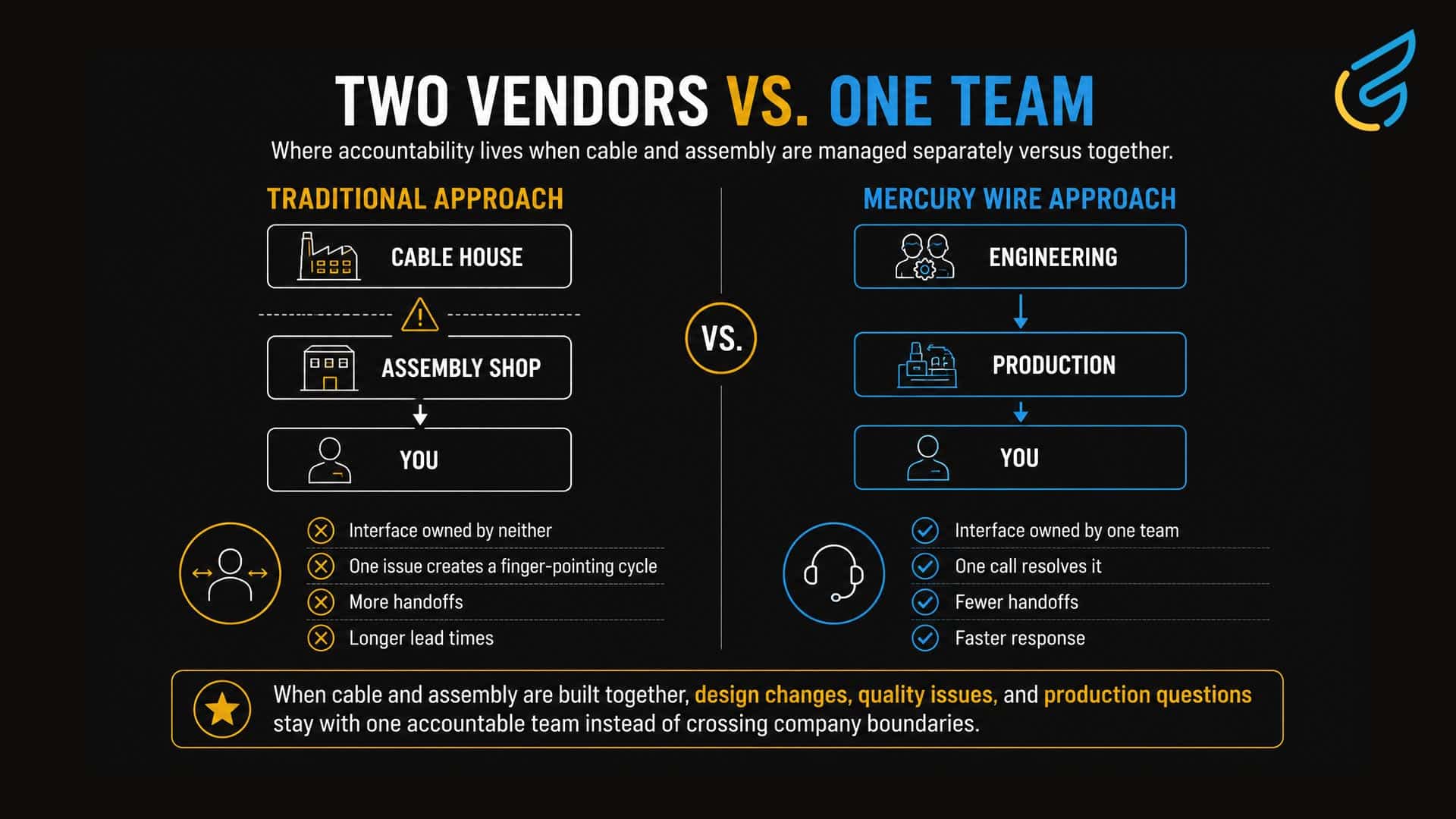
One supplier who engineers and manufactures both the cable and the assembly removes that interface. The complete design is owned by one team. One quality process. One accountability point. When something needs to change, one call resolves it.
Do They Have Experience in Your Specific Application Environment?
Cable assembly performance in a medical clean room is not the same problem as performance in a continuously submerged subsea instrument or a robotics end effector that flexes one million cycles per year.
An assembly manufacturer with direct experience in your application environment has already solved the problems specific to it. They know which termination methods hold up under vibration. They know which overmold geometries maintain seal integrity through thermal cycling. They know where flex fatigue initiates and how to design the strain relief to prevent it.
An assembly manufacturer without that experience will build what the drawing specifies. Whether it performs in the field depends on whether the drawing captured the right requirements. Drawings written by engineers who have not seen the application fail often do not.
Ask for application examples that match your environment. Not the industries they serve. Specific examples of assemblies they have built for similar conditions, with the design decisions they made and why.
A Practical Evaluation Checklist
Before shortlisting a cable assembly manufacturer, an OEM engineer should be able to answer these questions about each candidate:
- 01
Does this supplier engineer the cable in-house, or do they source it from an outside vendor?
A supplier who sources cable externally does not own the full engineering picture. Look for in-house cable engineering and manufacturing, not just assembly.
- 02
Will I speak directly with the engineers building my product, or go through a sales or customer service layer?
Ask who you call with a design question six months in. A direct engineering contact predicts a very different relationship than a support ticket system.
- 03
What is their documented process from specification receipt to validated prototype, and how do they handle revisions?
Concrete timelines and specific revision ownership indicate real experience. Vague answers about typical lead times indicate a quoting operation, not an engineering one.
- 04
How do they document validated designs and ensure quality consistency across production batches?
Quality problems that surface on the third or fourth shipment are almost always a process discipline failure. Ask how the validated design transfers to the production floor.
- 05
What happens when I need a design change on a part already in production?
Ask them to describe it from a real example, not hypothetically. How this works predicts the relationship tax you will pay every time something needs to change.
- 06
Can they produce both the cable and the assembly under one roof?
Two vendors means two engineering pictures and one accountability gap. Interface failures: connector retention, overmold adhesion, dimensional fit. These are never owned by either supplier. They are owned by you.
- 07
Do they have specific experience with assemblies in my application environment?
Ask for real examples from your environment: subsea, robotics, defense, medical. Not a list of industries served. Design decisions made for similar conditions are the proof.
- 08
What does their supply and inventory model look like for repeating production orders?
A supplier built for production programs should be able to align delivery schedules to your actual inventory needs: same day, weekly, monthly. Not just quote lead times at RFQ.
A supplier who can answer all eight of these questions with specific, concrete answers is a supplier who has solved these problems before. Vague answers or redirection to marketing materials are signals that the capability does not match the positioning.
What to Do With This Information
Evaluating a cable assembly manufacturer is not a quoting exercise. It is an engineering process. The suppliers who perform best over a five-year production program are the ones who engaged with the application before they quoted it, who could describe a design change process from experience, and who owned the full engineering picture, cable and assembly, from the beginning.
If you are currently evaluating cable assembly suppliers and want to talk through what your program requires, speak with one of our engineers. We will ask the application questions before we ask anything about the budget.