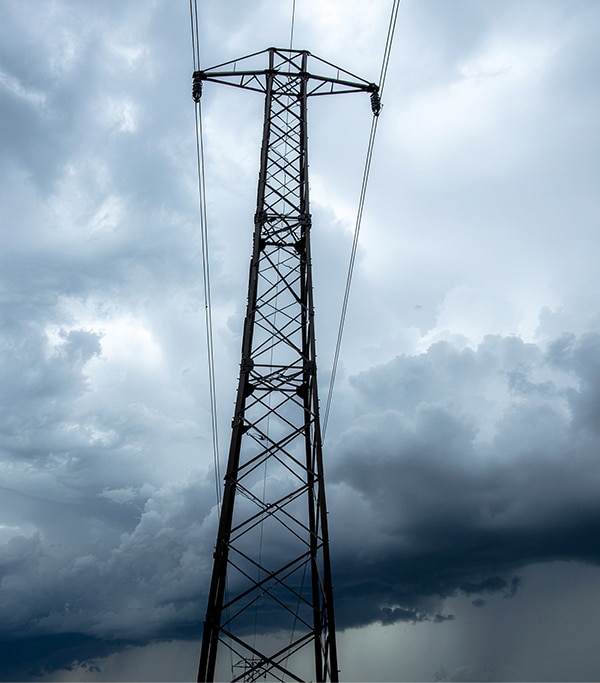
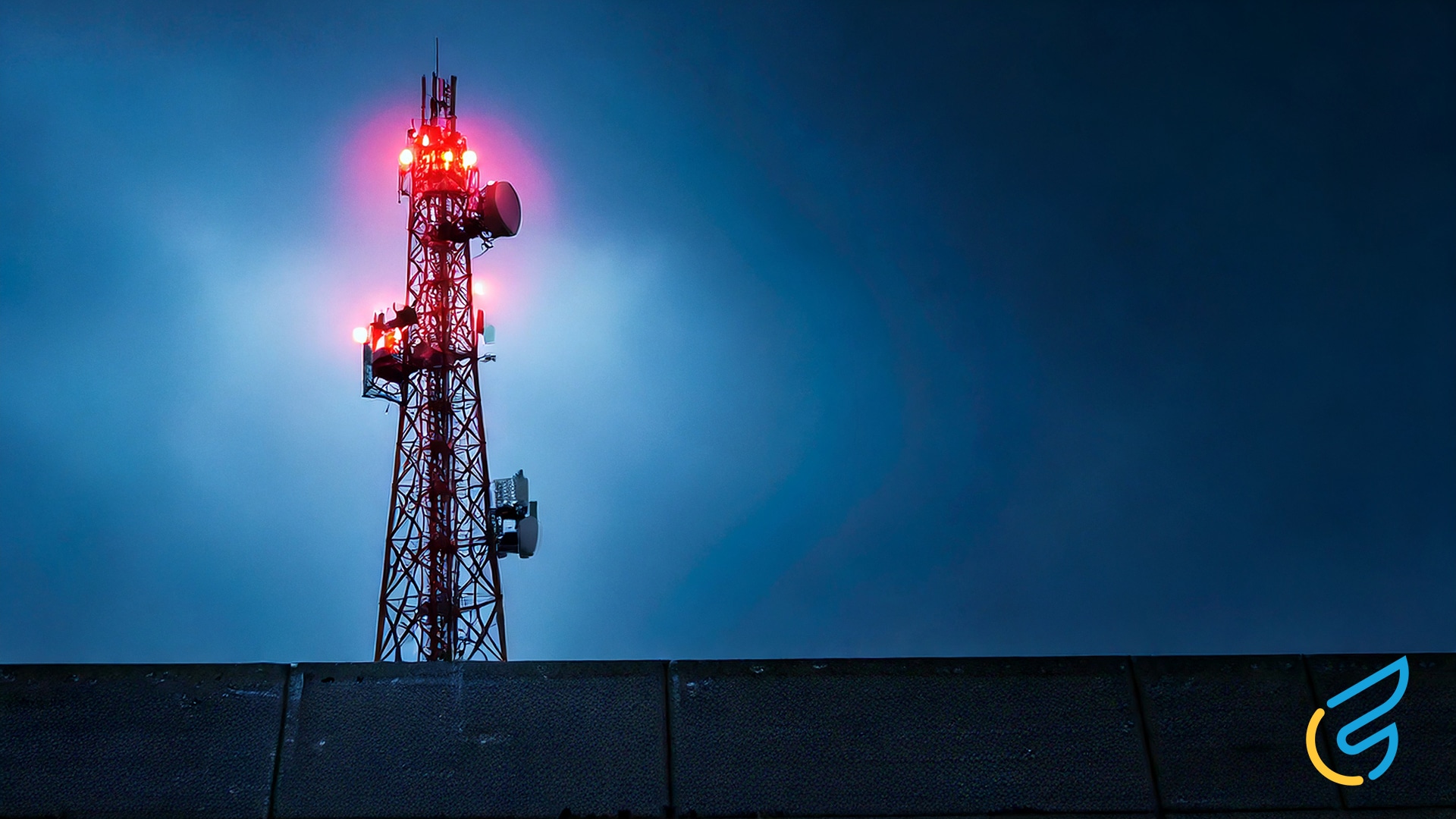
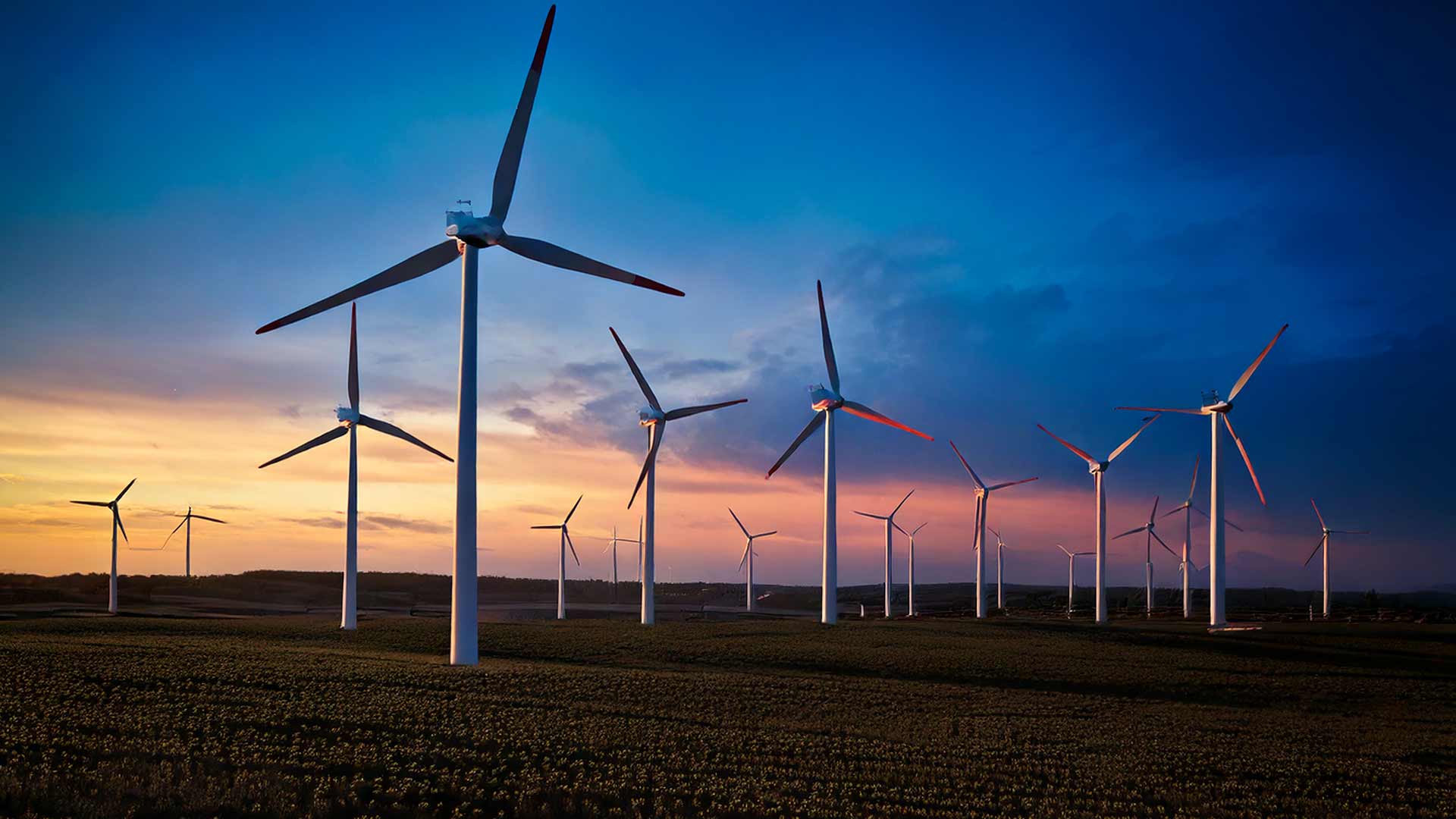
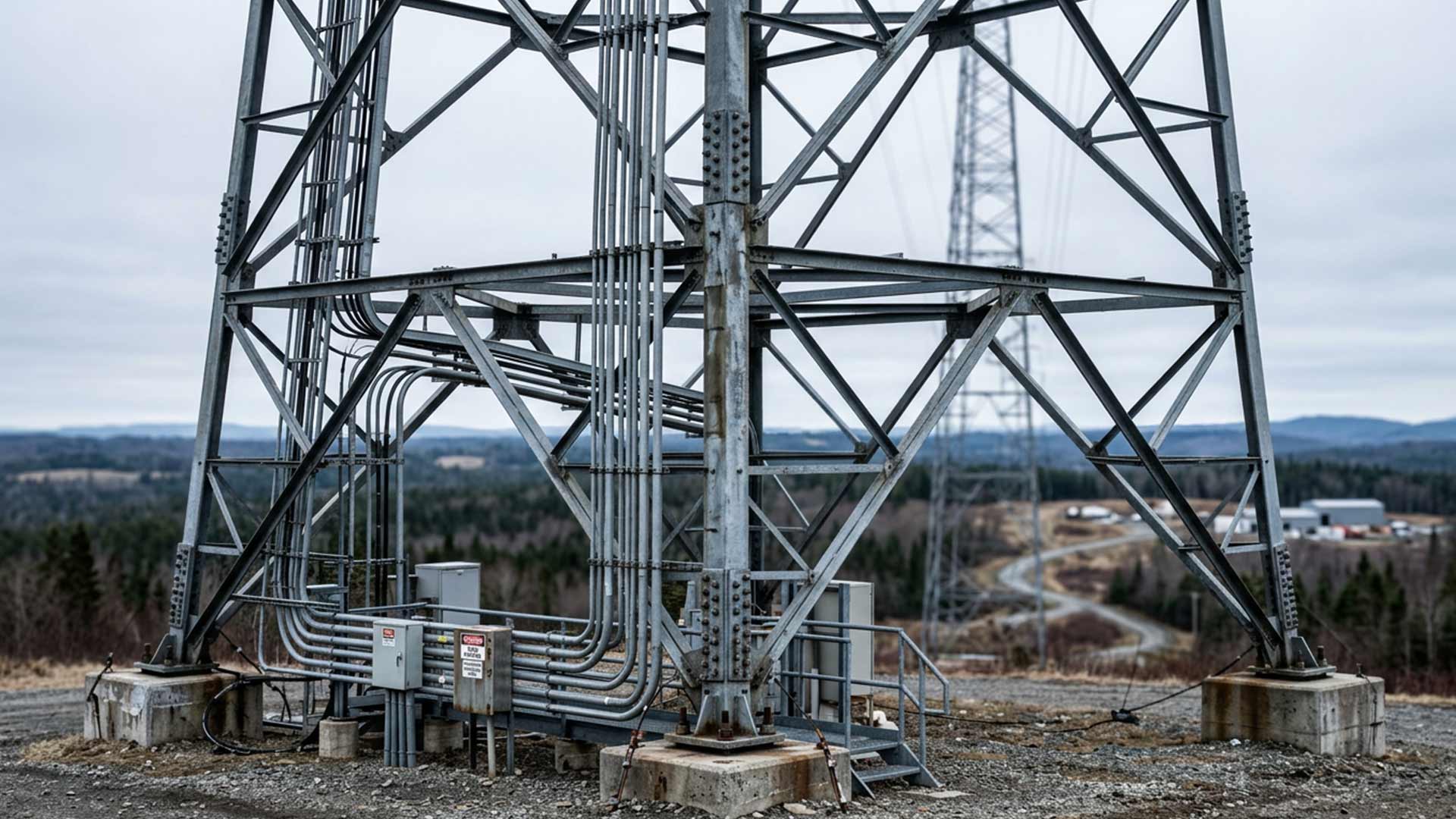
Wind turbines. Broadcast towers. Offshore platforms. These systems run unattended for decades and the cable connecting them has to last just as long. We engineer obstruction lighting cable for the actual installation environment, so reliability is built into the specification before the tower goes up, not discovered after the first field failure.
Years in US Manufacturing
Advisory Spec Review
Owns Your Project
Nationwide
Obstruction lighting cable does not fail in a lab. It fails on a tower after years of UV exposure, five winters of thermal cycling, and one season of standing moisture in a conduit that was never quite watertight. By the time the fault shows up in the system, access to the cable run costs more than the original installation.
Standard outdoor cable meets electrical requirements. Obstruction lighting failures happen when environmental requirements were never engineered. FAA Advisory Circular 70/7460-1 tells you what the lighting system has to do. It does not specify the cable. That gap between the regulatory requirement and the cable specification is where projects get into trouble.
We engineer obstruction lighting cable from the application up, working directly with your engineering team on jacket chemistry, conductor sizing, shielding, and water-blocking before production begins. The goal is a cable that performs from commissioning through the full service life of the structure, without surprises.
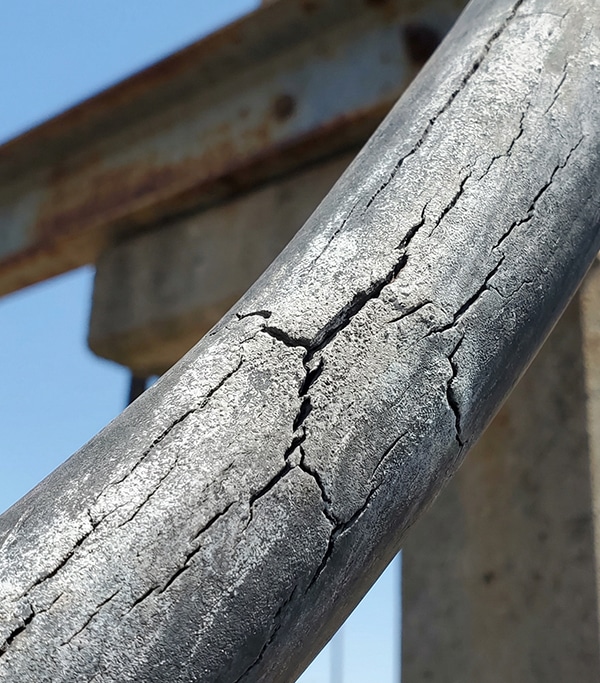
UV radiation and thermal cycling do not announce themselves. They compound quietly over years until the jacket cracks, the insulation loses dielectric integrity, and a system that passed commissioning begins to fail in the field. Tower-mounted cable runs face full UV load with no shade and temperature swings that standard PVC compounds were never formulated to survive across the structure’s full service life.* We select polymer chemistry for the cumulative environmental load of the installation, not the conditions in a test chamber.
Towers flex. Wind loads, thermal expansion, and vibration translate directly into repeated bending stress at every support point and termination. Standard cable constructions are specified for fixed installations where the conductor does not move. Obstruction lighting cable on a live structure does move, and conductor fatigue and insulation damage accumulate at every point where the construction was not designed for it. We engineer conductor geometry and cable flexibility to the mechanical reality of the structure, not the static assumption.
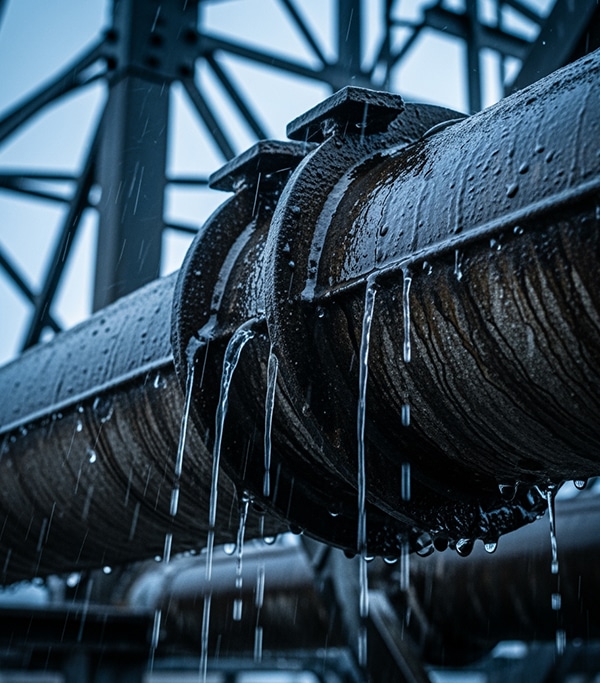
Water finds every path that the original specification did not close. A single jacket breach in an exposed outdoor run can carry moisture along hundreds of feet of cable before it reaches a termination and causes a fault. In broadcast tower environments, unshielded signal cable running alongside power feeds picks up RF interference that looks like an electrical fault and is nearly impossible to diagnose from the ground. Water blocking and site-specific shielding are not upgrades. They are the correct specification for these environments.
FAA Advisory Circular 70/7460-1 defines what the lighting system must do. It does not define what the cable must survive. Closing that gap is a shared responsibility between your engineering team and ours, and it has to happen at the specification stage, before installation, not after the first field failure. For a full breakdown of what FAA Advisory Circular 70/7460-1 requires and what it leaves to the engineer, [read our obstruction lighting cable specification guide]. We work with you to align cable construction to your actual environmental exposure, structural conditions, and service life expectations. The conversation is worth starting early. It is the only time it is inexpensive.
Every tower installation is different. Structure type, geographic exposure, and system design all shape what the tower lighting cable actually needs to survive. We engineer for the specific environment, not around whatever catalog construction gets closest.
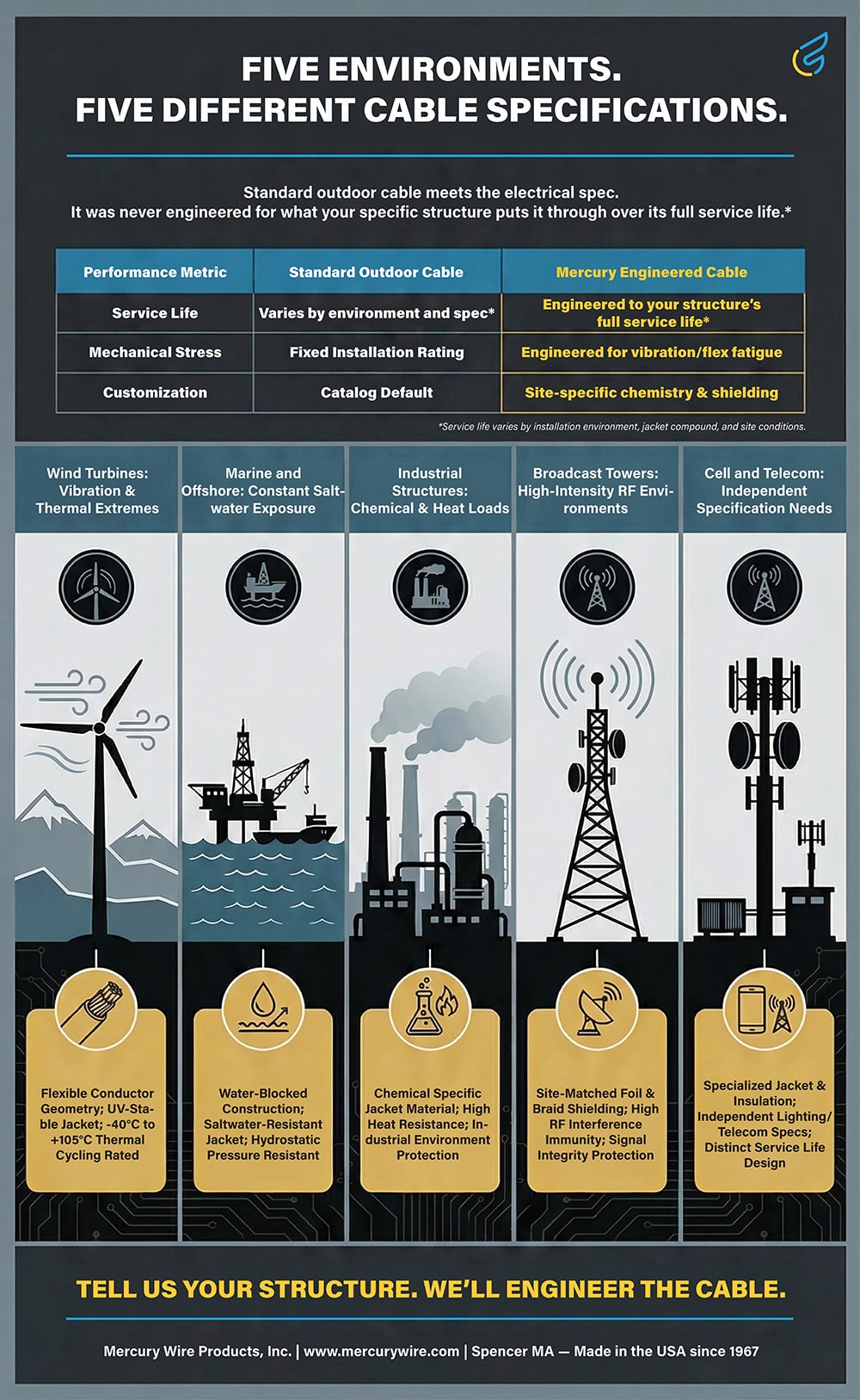
FAA regulations require obstruction marking on wind turbines above 200 feet AGL. Cable runs from the base to the nacelle and tip light, spanning the full height of the tower, in an environment defined by wide temperature swings, continuous vibration, and direct outdoor UV exposure. We engineer cable for the thermal and mechanical demands of the full tower height, with jacket compounds and conductor configurations selected for the specific rotor environment.
Broadcast towers co-located with AM and FM transmitters create among the strongest electromagnetic environments in the industry. Signal cables running through these environments need proper shielding, foil, braid, or combination, or they pick up interference the lighting control system was never designed to filter. Our shielding solutions for broadcast tower obstruction lighting are built around the RF environment at your specific site, not a generic spec applied from a catalog. If broadcast tower installations are part of your work, learn how we approach RF-dense environments.
Obstruction lighting on cell towers and telecom structures requires cable that survives years of outdoor exposure with minimal or no maintenance access. The cable specification needs to account for the tower’s environmental exposure: UV, moisture, and temperature, independent of the telecom cable running on the same structure. We engineer the obstruction lighting cable for the lighting system application, not adapted from a telecom specification.
Bridge lighting, maritime buoy systems, and offshore platform obstruction marking all require cable that holds up to saltwater, UV, and the mechanical stress of marine installations. Water-blocking is the correct specification for these environments. It is not optional. Our water-blocked cable constructions are engineered for outdoor and submerged marine applications where moisture ingress is a certainty, not a risk. If your installation is marine, offshore, or subject to direct weather exposure over a long service life, learn how we engineer water-blocked constructions.
Smokestacks, storage tanks, cooling towers, cranes, and tall industrial structures all require FAA obstruction marking above threshold heights. These structures often present additional cable challenges: chemical exposure, elevated ambient temperatures, and installation environments that standard outdoor wire was not rated for. We engineer cable for the structure’s specific operating environment, selecting jacket materials and construction methods that match the actual conditions, not the general category.
Every obstruction lighting cable we produce is engineered around the specific requirements of the installation, not selected from a catalog. The table below reflects our typical design envelope. Your application may require a different specification, and that conversation starts with your engineering team and ours.
| Specification | Typical Range or Capability |
|---|---|
| Temperature Rating | -40°C to +105°C |
| Jacket Material | Polyurethane (PUR), TPE, PVC, and Polyethylene — selected for UV stability, thermal cycling range, and chemical resistance at the installation site |
| Shielding | Foil, braid, or foil-and-braid combination — braided shielding for high-flex tower applications; foil or combination construction matched to the RF environment at broadcast tower and co-located transmitter sites |
| Water Blocking | Dry blocking (absorbent swelling tape) or gel-filled (water-repelling compound) — both methods stop moisture migration at the point of ingress; specified based on exposure type and installation environment |
| Conductor Gauge | Engineered per system voltage, current draw, and run length |
| Number of Conductors | Single, multi-pair, and multi-conductor configurations available |
| Insulation | PVC, PE, or cross-linked compounds selected for voltage rating and temperature range |
| Armor | Steel wire armor available for direct burial and exposed mechanical environments |
| Voltage Rating | 300V standard; 30V, 100V, 600V, and 1000V available |
| Assembly | Termination, connectorization, and weatherproof overmolding available |
| Manufacturing | Spencer, Massachusetts — Made in the USA since 1967 |
| All Specifications Are Application-Specific | Specifications reflect our typical design envelope. Your application may require a different construction. Contact our engineering team to confirm the right specification for your installation. |
No distributors, no middlemen, no service tickets. When you work with Mercury Wire, you work directly with the engineering team designing and manufacturing your cable. Questions get answered by engineers, not account managers.
We do not adapt a standard outdoor cable to your obstruction lighting application. We start with your system requirements: voltage, run length, environmental conditions, and FAA compliance context, and build a cable specification from the ground up.
Once we engineer your obstruction lighting cable, it becomes your standard production item. Consistent quality batch to batch, predictable lead times, and a supply partner who understands your application the way your team does. Because they helped design it.
Mercury Wire has manufactured in Spencer, Massachusetts since 1967. U.S.-based manufacturing means faster response, direct communication, no customs delays, and a supply chain partner you can reach when something matters.
If your obstruction lighting system requires finished assemblies, terminated runs, connectorized cable, or weatherproof overmolded connections, we engineer the cable and the assembly together. One specification, one team, no coordination gap between the cable and the assembly house.
See how we handle integrated cable and assembly for obstruction lighting systems, including termination, connectorization, and weatherproof overmolding. →


Obstruction lighting systems require cable with a UV-stabilized outdoor jacket, a temperature rating capable of handling the full ambient range at the installation site (typically -40°C to +105°C) and depending on the application EMI shielding for RF environments and water blocking for marine or exposed outdoor installations. These cables are also specified as aviation warning light cable in FAA compliance and OEM design contexts. Standard outdoor cable meets the electrical requirements but not the environmental requirements for long-term outdoor service life. Aircraft warning light cable is a related term used by buyers specifying for FAA advisory compliance on towers and structures above navigable airspace.
Standard outdoor cable is rated for the electrical load. Obstruction lighting cable is engineered for the environmental load — UV exposure, thermal cycling, moisture ingress, and in some tower environments, electromagnetic interference. The difference shows up after year five in the field, not in year one. Mercury Wire engineers’ obstruction lighting cable to perform reliably across the structure’s full outdoor service life.*
FAA Advisory Circular 70/7460-1 governs obstruction lighting systems — what lights are required, their intensity, flash rate, and positioning. The advisory circular does not specify the cable. Cable specification is the engineer’s responsibility, and it must support the system’s performance requirements across the full environmental envelope of the installation site. Mercury Wire works with engineers specifying new systems and with teams troubleshooting failures in existing ones.
Yes. We engineer and produce cable assemblies for obstruction lighting applications alongside the cable itself — including terminated runs, connectorized assemblies, and weatherproof overmolded connections. Cable and assembly production happens under one roof in Spencer, MA, with one dedicated team owning the project from design through delivery.
Lead time depends on the cable construction and production volume. The best starting point is a design conversation — share your specifications, run length, and volume requirements and we will give you an accurate production timeline. We support both prototype quantities and ongoing production supply with Kanban inventory options for customers who need continuous, predictable replenishment.
Yes, wind turbine obstruction lighting cable is one of our primary application focuses. The engineering requirements are specific — wide temperature range, UV-stabilized jacket for outdoor exposure from base to tip, and mechanical flexibility to accommodate tower movement and vibration. We design cable constructions around the turbine’s tower height, environmental conditions, and FAA compliance requirements.
Yes. Broadcast tower installations require particular attention to EMI shielding. Co-located AM and FM transmitters create electromagnetic environments that can interfere with obstruction lighting signal cables. We engineer shielded obstruction lighting cable — foil, braid, or combination for broadcast tower applications where RF interference is a real-world concern.
The most expensive obstruction lighting cable problems are the ones that show up after installation, when the tower is already in service and access costs more than the original cable run. Getting the specification right starts with a conversation between your engineering team and ours. That conversation is worth having early. It is the only time it is inexpensive.
Or send us your specifications directly → sales@mercurywire.com · (508) 885-6363
Explore engineered capabilities, shielding expertise, and related applications.
Key specification guidance for obstruction lighting cable design
Engineered obstruction lighting cable designed for tower-specific demands
Integrated cable, connectorization, and finished assembly support
Foil, braid, and combination shielding for EMI sensitive systems
Engineered cable for outdoor, exposed, and harsh sensing environments
Reliable cable solutions for power, control, and communication systems
Share your application and speak directly with our engineering team.
*Engineered service life varies by installation environment, jacket compound, conductor specification, and site conditions. Mercury Wire engineers cable to your specific application and service life requirements.
Receive updates directly in your inbox!