
Cable Assembly Manufacturer
Most assembly suppliers build exactly what you send them. We start with your specification as a baseline, ask the questions your drawing does not answer, and build what your application actually requires.
If you have ever had an assembly that passed incoming inspection and failed in the field, the gap usually starts with the cable. Your assembly shop did not design it. Your cable supplier did not know how it would be assembled. Nobody owned the interface between the two.
Mercury Wire has been engineering and manufacturing in Spencer, MA since 1967. We produce the cable and build the assembly in the same facility, with the same engineers responsible for both. That integration is not a convenience feature. It removes a full layer from your supply chain and closes the gap where most assembly problems originate.
If you are a design engineer or procurement lead evaluating cable assembly manufacturers, speak with one of our engineers to get started.
What Is a Cable Assembly Manufacturer?
A cable assembly manufacturer produces finished, ready-to-install cable assemblies by combining cable with connectors, terminations, overmolding, strain relief, and any other components required for your application. At Mercury Wire, this means engineering the cable construction and the assembly design together from the start, which can include sourcing a stock cable and electronic components, as well as supporting the engineering of the assembly design by recommending alternatives based on your application requirements.
For most OEMs and system integrators, the assembly is not a commodity. It transmits power or signal, survives mechanical stress and environmental exposure, connects directly to the equipment it supports, and must perform reliably for the life of the product. When the cable was not designed with the assembly in mind, or the assembly house received a cable they had no input on, that interface is where problems start.
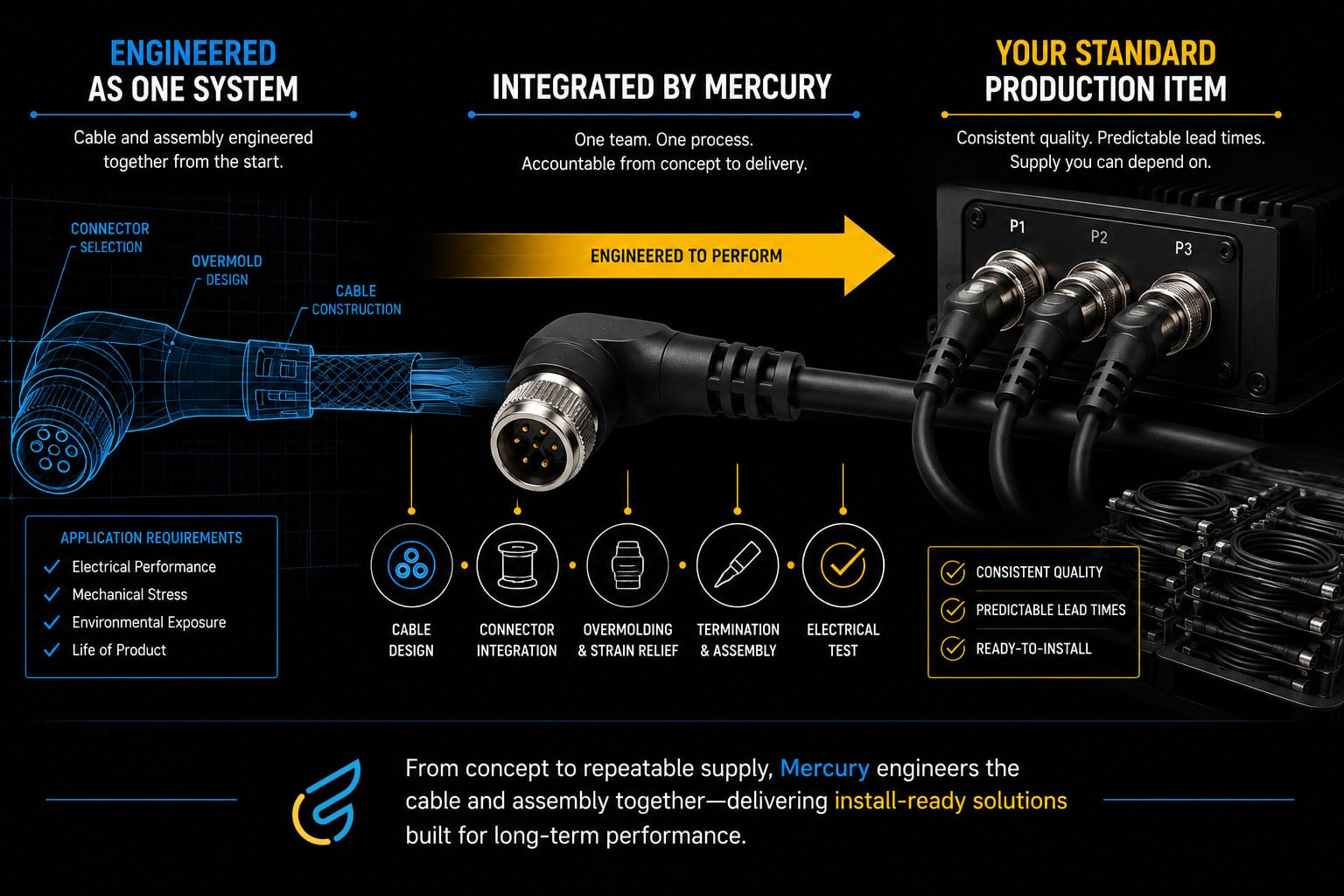
At Mercury Wire, cable assembly manufacturing includes every stage: cable design and production, connector selection and attachment, termination, soldering, crimping, overmolding, potting, strain relief, harness construction, and final electrical test. The result is not a special order. It becomes your standard production item, consistent quality, predictable lead times, available when your schedule demands it.
One supplier. One engineering team. One accountability point. Managing a cable house and an assembly shop separately means you own the interface between them. Tolerance stack-ups, quality disputes, and schedule delays all land on your team when two suppliers are pointing at each other. We engineer the cable and build the assembly in-house in Spencer, MA. One conversation, one program, one point of contact from prototype through production.
Managing a cable house and an assembly shop?
If the interface risk between your cable supplier and your assembly shop lands on your team when quality problems appear, that is the problem we are built to solve. We manufacture the cable and build the assembly in the same facility with the same engineers. One conversation replaces two.
Cable Assembly Capabilities at Mercury Wire
We engineer and build your cable and assembly under one roof. That integration removes a full layer from your supply chain, accelerates prototyping, and keeps quality accountability where it belongs: with the team building your product.
Connector Selection and Attachment
Choosing the wrong connector for the application creates failures that are expensive to diagnose after production has started. Wrong environmental rating, inadequate retention force, incorrect keying, or a connector-to-cable interface that was not designed together all fail in the field in ways that a draw-to-print assembly house will not catch.
We select connectors based on your electrical requirements, environmental exposure, mating cycle count, and mechanical loads. Because we designed the cable, we know how the connector interface will perform over the life of the assembly.
Termination, Soldering, and Crimping
Termination quality determines whether your assembly performs the first time and the hundredth time. We perform solder, crimp, and insulation displacement terminations to IPC-A-620 workmanship standards. Every method is documented, process-controlled, and repeatable across production batches.
Overmolding and Potting
Overmolded and potted assemblies survive environments that standard terminated assemblies cannot. Strain relief, water ingress protection, connector-to-cable interface sealing, and mechanical strength at the cable exit point all depend on the overmold design being matched to the cable construction and the application’s environmental requirements.
We design and produce overmolded assemblies using injection molding at our Spencer, MA facility. Because we produce the cable, the overmold geometry is designed around the actual cable construction.
Wire Harness Construction
Wire harnesses integrate multiple cables, branches, and connectors into a single, routed assembly ready for installation in your product. We build harnesses to your design, with branch points, breakout geometry, and conductor routing matched to your mechanical layout.
Because we manufacture the individual cables in-house, we control the starting point for every conductor in the harness. That consistency carries through to the finished harness and simplifies incoming inspection on your end.
In-House Testing and Electrical Validation
Every assembly we ship is tested before it ships. In-house electrical test capabilities include continuity, hi-pot, and application-specific test sequences built around your requirements. We build the test fixtures and run the test protocols to your specification.
Test documentation is part of the production record. When you need traceability, for defense programs, medical applications, or high-reliability industrial systems, the records are there.
We also support PPAP (Production Part Approval Process) for customers who require documented evidence that our production process will consistently produce parts meeting their engineering design requirements. PPAP documentation is built into the production record for applicable programs.
Short-Run Prototyping
We build prototypes in-house, which means the prototype reflects the actual production process: same materials, same equipment, same workmanship standards. If the prototype needs a revision, we make it ourselves. There is no outside vendor to coordinate and no lead time to absorb for the change.
Assembly-only prototypes are typically ready within 21 days. Programs that require us to engineer and produce the cable as part of the prototype run 6 to 7 weeks, depending on construction complexity. The fastest way to get an accurate timeline is a direct conversation with our engineering team.
Mold Design and Injection Molding
For assemblies requiring application-specific overmold geometry, we support mold design and produce overmolded parts using low-pressure injection molding at our facility. This enables strain relief profiles, connector backshells, and cable exit designs that cannot be achieved with standard shrink or boot terminations.
IPC-A-620 Assembly Workmanship: Our assembly team is trained to IPC/WHMA-A-620 workmanship standards the recognized industry standard for cable and wire harness assembly quality. This applies to every production order, not just first articles or customer-audited runs.
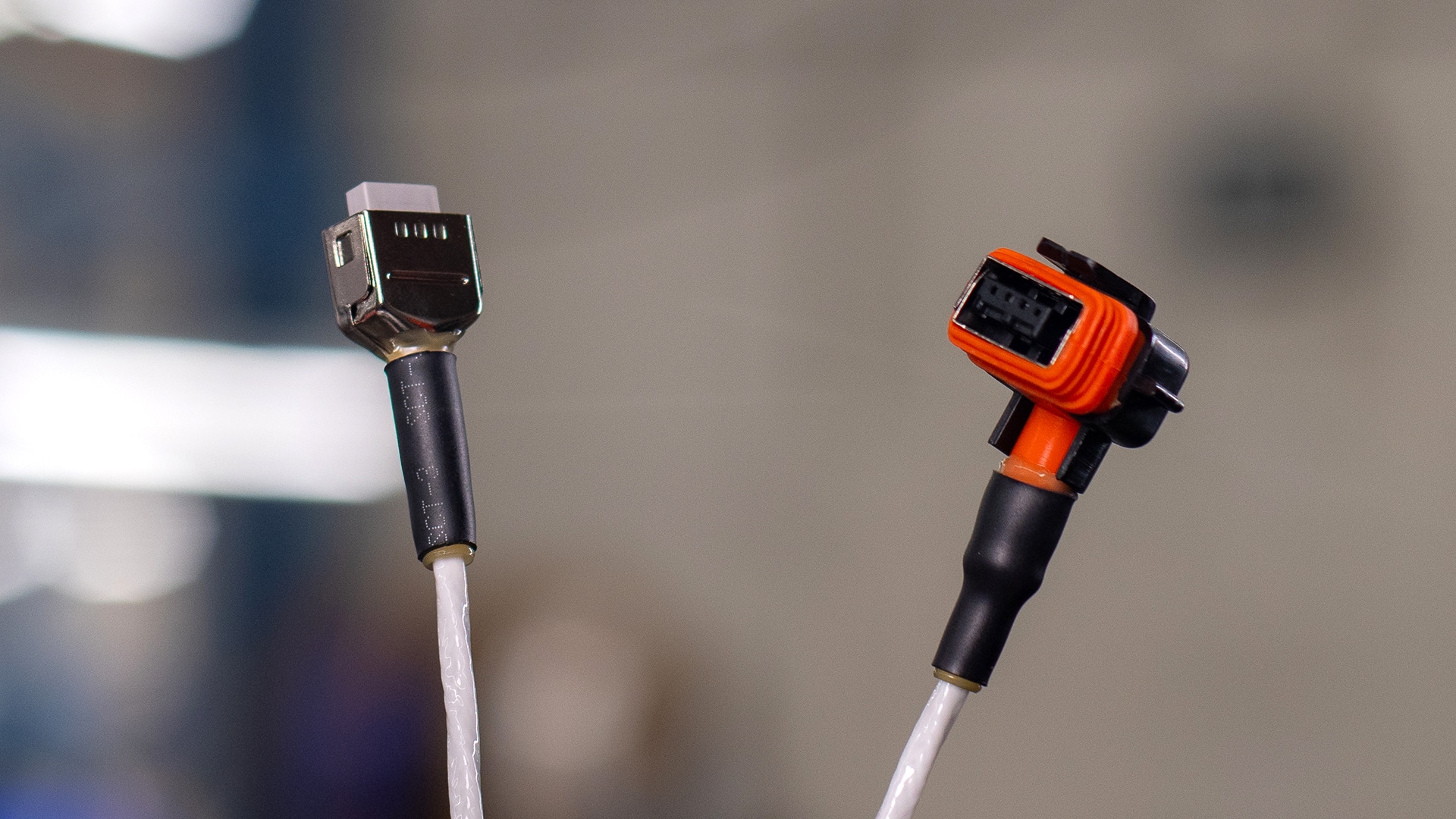
Why Cable and Assembly Under One Roof Changes Everything
Most cable manufacturers build cable and ship it somewhere else for assembly. Most assembly houses receive cable from suppliers they had no hand in designing. The result is an interface nobody owns.
When tolerance stack-ups occur, both suppliers have a defensible position. When quality fails, the root cause investigation requires cooperation from two organizations with competing interests. When you need a design change, you are coordinating two separate engineering conversations instead of one.
The integration advantage at Mercury Wire is not just convenience. It is a structural difference in how the product is built and who is accountable for it.
When the cable and assembly are engineered together, the connector interface is designed around the actual cable geometry, not a standard envelope. The overmold design accounts for the cable’s flexibility characteristics. The termination method is matched to the conductor material and insulation type. The test protocol is written for the complete assembly, not the cable and the termination separately.
Once a design is validated, both the cable and the assembly run from the same production documentation, with the same quality process, batch after batch. That is what repeatable supply actually means.
Industries We Build Cable Assemblies For
We work across a range of application-specific markets. The common thread is engineering complexity. These are applications where a build-to-print assembly shop is not enough.
Geotechnical and Push Cable
Structural monitoring instruments and push cable systems demand cable assemblies that survive repeated mechanical loading, outdoor exposure, and long sensor runs without degrading signal or structural integrity. We engineer the cable and the termination together for field performance, not lab conditions.
Geotechnical cable and assembly →Obstruction and Emergency Lighting
Tower, wind turbine, and emergency lighting assemblies need cables built to survive UV exposure, temperature cycling, and weathering across a service life measured in years. We are one of the few U.S. manufacturers engineering cable assemblies specifically for these applications.
Obstruction lighting cable →Underwater and Subsea
Continuously submerged assemblies require water-blocked conductors, corrosion-resistant materials, overmolded strain relief, and pressure-rated jacketing. We have built assemblies deployed at 850 meters underwater. The engineering starts with what the environment will actually do to the cable over time.
Underwater cable and assembly →Military and Defense
Defense assembly programs require engineering discipline, supply chain traceability, and a U.S.-based manufacturing partner who understands the documentation requirements. We build to your specification and stand behind the work through production.
Military and defense →Robotics and Industrial Automation
Dynamic load, continuous flex, torsion, vibration, and chemical exposure destroy standard assemblies in high-cycle industrial environments. We engineer cables and assemblies for the specific mechanical regime of your robotic system so failures do not halt your production line.
Industrial cable →Environmental and Water Monitoring
Sensors and data loggers deployed outdoors and in water need assemblies that survive temperature swings, wet conditions, and long-term field exposure without degrading the signal they carry. We have built cable and assembly families for water quality monitoring OEMs with 15-year production histories.
Environmental monitoring cable →Medical (Non-Invasive)
Surgical instruments and non-invasive medical devices require assembly workmanship where dimensional consistency, cleanliness, and repeatability are not optional. We build medical cable assemblies to IPC-A-620 standards for OEM partners who cannot afford incoming inspection surprises.
Medical cable →Aerospace
Aerospace assembly programs have no room for approximation on weight, temperature range, fluid resistance, or connector performance. We build to specification for aerospace OEMs who need an engineering partner, not a catalog supplier.
Aerospace →Pipeline and Sewer Inspection
Push rod assemblies for video inspection systems require a precise combination of cable column strength, flexibility, and connector durability at the cable-to-camera interface. We have engineered application-specific assemblies for OEMs in this space.
Push rod cable →Have a drawing you need built?
Send us your assembly specification. We will review the construction, ask the application questions your current supplier probably did not, and tell you exactly what we would do differently — and why. No charge for the review.
Why Engineers Choose Mercury Wire for Cable Assembly Manufacturing
There is no shortage of assembly houses. Mercury Wire is a cable assembly manufacturer in Spencer, MA, engineering and manufacturing since 1967. We produce the cable and build the assembly in the same facility and delivers with enough consistency that your incoming inspection becomes a formality.
- You talk to the engineers building your product.
No account managers relaying information. No quoting desks that forward your drawings to a production team you will never speak to. When you call Mercury Wire, you reach the engineers who will build your assembly. That direct access compresses every part of the program, from first conversation to validated prototype to production release.
- When your last supplier went dark, that is when engineers find us.
In the past year, the most common reason engineers have come to Mercury Wire is that their previous supplier stopped communicating. The cable arrived late or not at all. Questions went unanswered. Design change requests went into a system and never came back out. What those engineers found here was the opposite: direct access to the team building their product, and a supplier who treats responsiveness as part of the product. You do not have to manage us. You hear back.
- Cable and assembly under one roof.
We produce the cable and build the assembly in Spencer, MA. The same engineers who designed your cable oversee the assembly that uses it. The interface between the two is not a handoff between suppliers. It is a single, managed design decision.
- Engineering collaboration, not build-to-print execution.
We review your application environment before we quote. Temperature range, flex life, connector mating cycles, chemical exposure, ingress protection requirements, mechanical loads at the cable exit: these shape the assembly design. A supplier who quotes without asking these questions will build what you sent, not what you need.
- Repeatable supply, not special orders.
Once your assembly is engineered and validated, it becomes a standard production item. Same cable construction, same assembly process, same quality checkpoints, batch after batch. Kanban inventory and pull-based replenishment mean the assembly ships when your production schedule demands it.
- U.S. manufacturing with real lead-time discipline.
We run lean. Value-stream production teams, kanban inventory management, and domestic supply chains mean faster response to demand changes and shorter lead times than overseas assembly programs. No customs delays. No time zone barriers. No supply chain exposure on the other side of an ocean.
How we manage lead time and delivery →
How the Cable Assembly Manufacturing Process Works
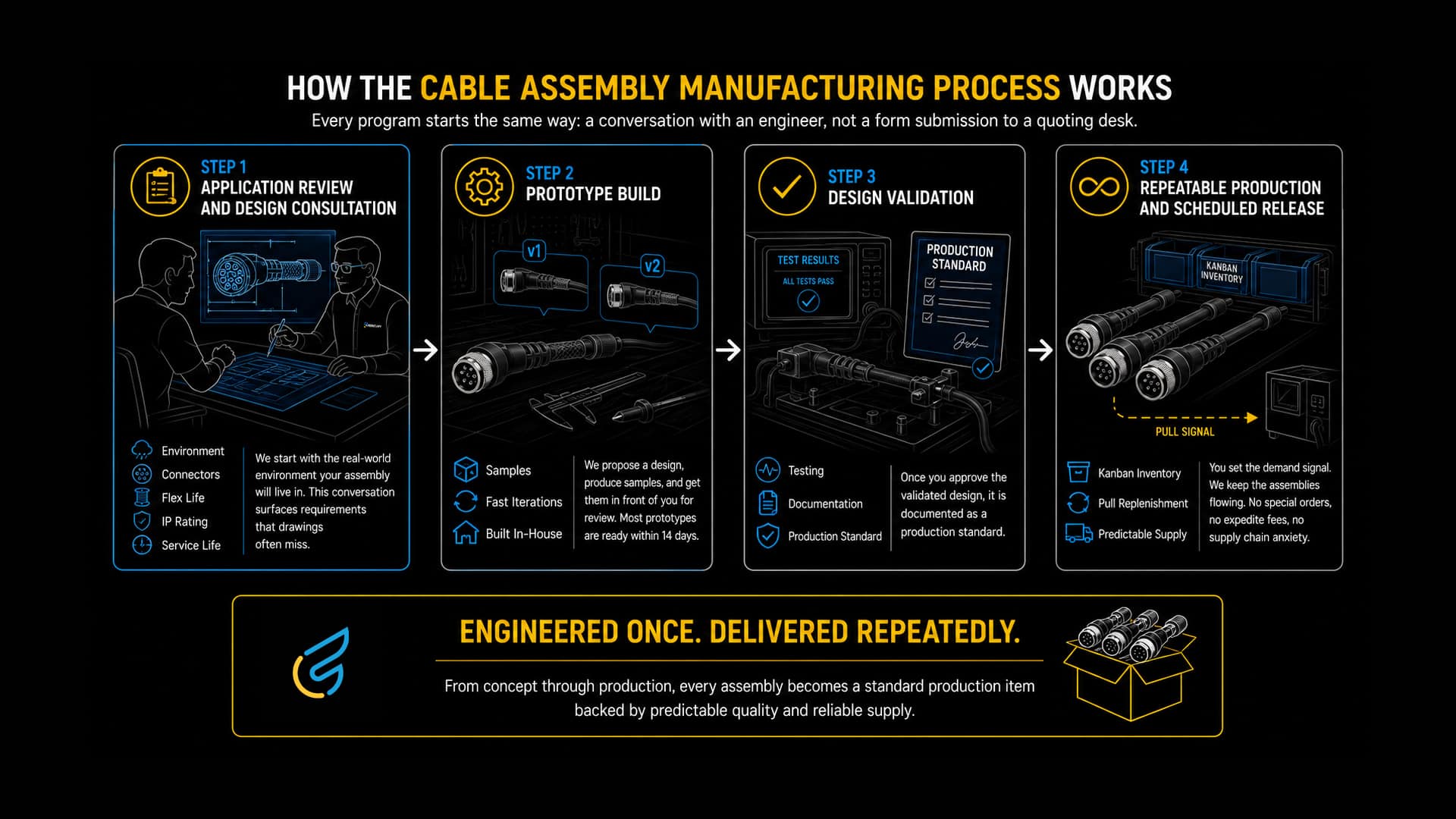
Every program starts the same way: a conversation with an engineer, not a form submission to a quoting desk.
Step 1:
Application Review and Design Consultation
We start with the real-world environment your assembly will live in. Connector requirements, cable construction constraints, mechanical loads, environmental exposure, ingress protection rating, flex life expectations, and service life targets. This conversation surfaces requirements that drawings often miss. That is exactly where our value starts.
Step 2:
Prototype Build
Assembly-only prototypes are typically ready within 21 days. Programs that require us to engineer and produce the cable as part of the prototype run 6 to 7 weeks. Iterations are fast because every decision is made by the engineers doing the work.
Step 3:
Design Validation
Once you approve the validated design, it is documented as a production standard. The cable construction, assembly process, connector part numbers, test sequence, and workmanship requirements are all captured. Every subsequent production run is built from the same specification.
Step 4:
Repeatable Production and Scheduled Release
Kanban inventory and pull-based replenishment keep your production line supplied. You set the demand signal. We keep the assemblies flowing. No special orders, no expedite fees, no supply chain anxiety.
For customers on just-in-time production schedules, we have shipped assemblies with one-day lead time. Kanban-managed inventory means your assemblies are staged and ready before your production line calls for them. That model reduces the inventory liability you carry while eliminating the supply chain anxiety that comes with waiting on orders. You do not need to bulk-order three months of supply to protect yourself. We hold the buffer.
Ready to start your prototype?
If you have a cable assembly you are sourcing now, or a design you need validated, the fastest way to evaluate whether we are the right fit is to build it.Assembly-only prototypes turn in about 21 days. Cable-included prototypes run 6 to 7 weeks. The cable and the assembly are both built in-house, so we are not waiting on outside vendors to move.
Signs It's Time to Switch Cable Assembly Manufacturers
Most customers come to us because something went wrong somewhere else. They are not looking for the lowest price. They are looking for a partner who actually solves the problem. These are the situations we hear about most often.
Your cable assembly manufacturer builds to the drawing but doesn't understand the application.
A supplier who assembles what you send does not catch design problems. They build the spec, ship the order, and leave the application performance to you. When something fails in the field, the supplier’s answer is that the assembly met the drawing. We start by asking what the assembly has to survive, not just what the drawing says.
Your cable supplier and assembly shop are pointing at each other.
You are managing two vendors. When quality problems appear, each has a defensible explanation that blames the other. The interface between them, which nobody owns, is where most assembly failures start. One supplier who does both eliminates the interface entirely.
Lead times are unpredictable.
Your assembly supplier gives you a date. Then another date. Your production schedule absorbs the hit. We build with kanban inventory and lean scheduling specifically to eliminate that pattern.
Quality varies batch to batch.
First article looks right. Third shipment has a workmanship issue that shows up at incoming inspection or, worse, at final assembly. We treat process documentation and production consistency as a core deliverable.
Most batch-to-batch quality variation traces back to material, not workmanship. A connector supplier changes a dimension. A cable jacket lot ships with a slightly different durometer. Nobody checks. The problem appears at incoming inspection on batch four, and the root cause investigation takes two weeks. Before we build to a new specification, we verify that incoming materials match the design intent, not just the purchase order. Connector dimensions, cable geometry, jacket properties, and termination interface tolerances are all confirmed before the first assembly runs.
You need a design change and got a quoting desk instead of an engineer.
Your application evolved. The assembly needs to change. Your current supplier’s answer is a new NRE quote from someone you have never spoken to. Our answer is a direct conversation with the same engineers who designed the original.
Your current assembly supplier cannot engineer the cable.
You need a cable built to a specific construction and an assembly designed around it. Your current assembly house sources whatever cable is available and adapts to fit. That is a design process with no engineering input from the manufacturer.
How to Choose a Cable Assembly Manufacturer: What OEM Engineers Actually Need to Know →
Engineering In Practice
See how our engineering and assembly approach has worked for OEM partners across demanding applications.
A water monitoring OEM was sourcing cable from one supplier and assemblies from another. Quality inconsistencies were creating incoming inspection problems across product lines used by government agencies and environmental researchers. We consolidated cable and assembly under one roof, built a proprietary durability test rig to validate flex life, implemented ERP-based traceability, and grew the program to more than 15 cable and assembly families over 15 years. Read the case study.
A manufacturer of emergency equipment for first responders was running out of floor space and post-COVID assembly labor. Their engineers were spending time on assembly work that needed to happen in the space they needed for R&D. We set up a dedicated assembly line at our facility, identified a design element that did not meet regulatory standards and corrected it before production started, and removed the assembly burden entirely. Read the case study.
A continuously submerged application with no tolerance for water ingress, no second chance for failure, and no ability to retrieve the assembly for inspection. We engineered the cable and assembly together for the depth rating, strain loads, and service life the application required. Read the case study.
A manufacturer handling assembly in-house was constrained by floor space, labor cost, and turnaround time. We took over the full assembly operation, scaled their product families from 13 to more than 23, positioned production cells near shipping and receiving to cut handling time, and got orders out within 24 hours of receipt. Read the case study.
Cable Assembly Manufacturing: Frequently Asked Questions
A cable assembly manufacturer produces finished, ready-to-install cable assemblies that combine cable with connectors, terminations, overmolding, and any other components required for a specific application. At Mercury Wire, cable assembly manufacturing includes engineering the cable construction and the assembly design together, not just assembling to a drawing.
An assembly house builds what you send them. A cable assembly manufacturer with in-house cable manufacturing engineers the cable and the assembly as a system. The practical difference is who owns the interface between the cable and the assembly, and what happens when something fails.
Yes. We manufacture the cable and build the assembly in Spencer, MA. Both happen under one roof, with the same engineering team responsible for the complete solution. Most cable manufacturers do not build assemblies. Most assembly houses source cable from outside. We do both in-house, which removes the handoff that causes most of the tolerance, schedule, and quality problems in cable assembly programs.
Assembly-only prototypes are typically ready within 21 days. Programs that require us to engineer and produce the cable as part of the prototype run 6 to 7 weeks, depending on construction complexity. Because cable manufacturing and assembly both happen in-house, we are not waiting on an outside cable supplier to deliver materials before we can build. The fastest way to get an accurate timeline is a direct conversation with our engineering team.
Mercury Wire’s assembly team is trained to IPC/WHMA-A-620 workmanship standards. For customers in defense, medical, aerospace, or high-reliability industrial applications, this means our workmanship follows the recognized industry criteria — even without formal certification.
A contract cable assembly manufacturer produces cable assemblies to a customer’s specification as part of the customer’s supply chain. The contract manufacturer manages materials, production, quality, and delivery on a scheduled or pull-based basis. At Mercury Wire, this includes engineering support: we do not simply execute drawings, we review specifications, recommend improvements, and build the program to perform reliably across its service life.
Yes. We build wire harnesses as part of our cable assembly capabilities. Harness construction, including branched assemblies, multi-conductor bundles, and routed harness geometries, is built from cables we manufacture in-house. Because we produce the individual conductors, we control the starting material for every wire in the harness.
There is no hard minimum. We build small prototype runs for design validation and scale to full production volume once the design is established. The right conversation is about your volume profile over time, not just the first order. Both low-volume and high-volume programs go through the same engineering and quality process.
You talk to the same engineer who designed the original assembly. Not a quoting desk. Not a new RFQ process. The same person who knows the construction history, the application context, and what has been tried before. That direct access means design changes move faster and resolve more accurately than at suppliers who put a sales or customer service layer between you and the engineering team.
We work across geotechnical and push cable, emergency and obstruction lighting, underwater and subsea, military and defense, robotics and industrial automation, environmental monitoring, non-invasive medical, aerospace, and pipeline inspection. What these applications share is engineering complexity: situations where a standard cable assembly will not reliably perform and where the cost of field failure is high.