Key Takeaways
- Cable specs written at launch often stop reflecting the actual application. Environments change, production scales up, and what passed validation may no longer be optimal.
- Premature insulation wear, intermittent field failures under vibration, and assembly friction on the production floor are common signs an existing spec is due for review.
- A structured cable specification review covers five areas: environment and lifecycle, mechanical behavior, electrical performance, regulatory compliance, and manufacturability.
- A targeted change, such as different conductor stranding, jacket material, or shielding construction, can improve reliability and reduce cost without disrupting your product architecture.
- We offer no-cost reviews of existing cable designs for OEMs with established production programs.
Why Existing Cable Specs Are Never Revisited, and Why That Costs You
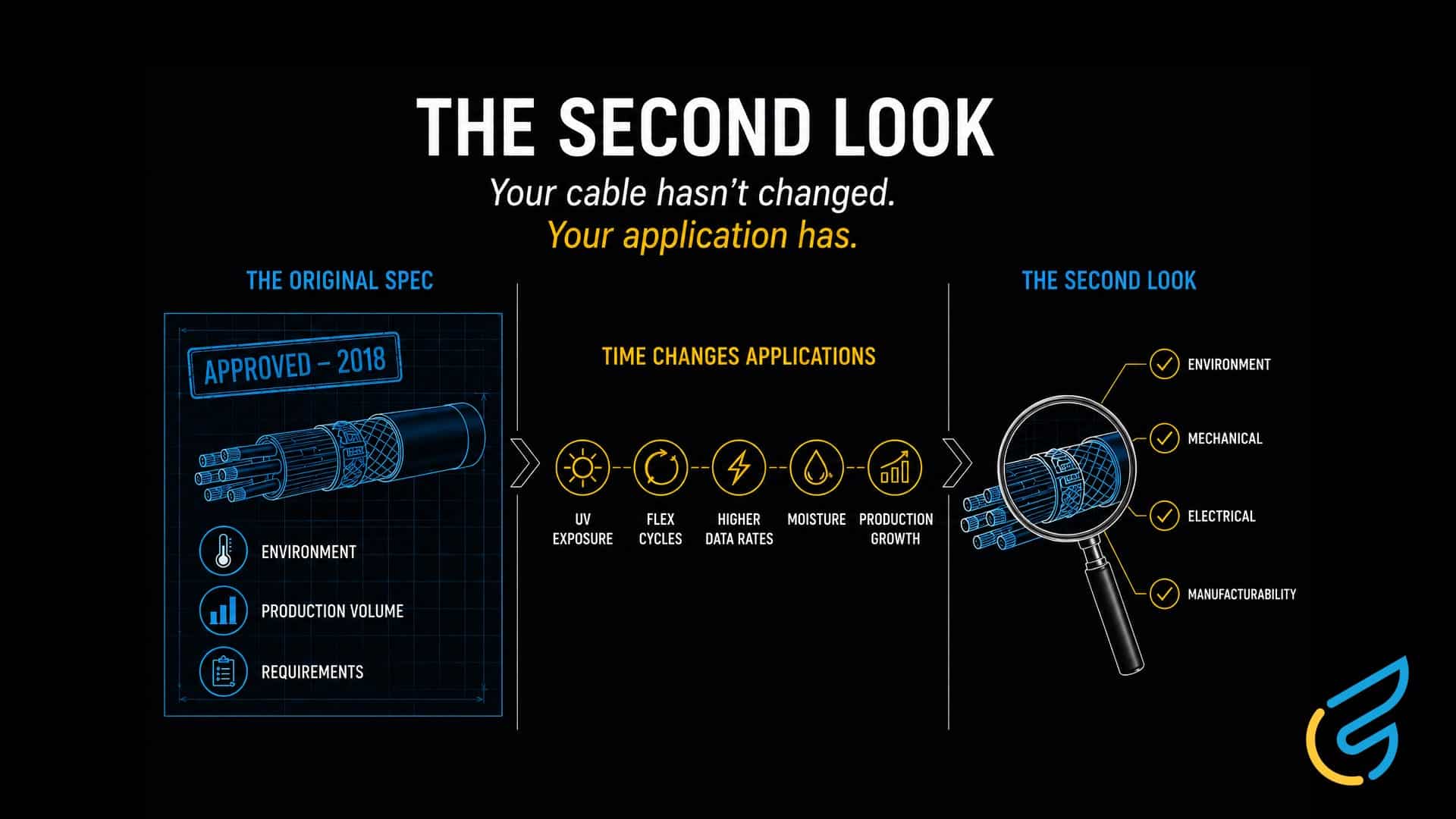
A cable specification written at the design stage reflects the constraints, materials, and assumptions of that moment. The application it serves rarely stays the same. Over years of production, environments shift, performance expectations rise, and assembly processes evolve. Yet most OEMs continue building to the original print without question.
The risk of revisiting a spec that is “working” feels real. Any change means retesting, potential requalification, and temporary disruption. What that calculus misses is the quiet, compounding cost of a cable that is merely adequate: premature field failures, assembly slowdowns, over-specified material cost that never gets challenged.
At Mercury Wire, we work regularly with engineering teams whose cable designs have run unchanged for five or more years. Through a structured cable specification review, those teams consistently find one or two targeted changes that deliver meaningful improvements in durability, assembly ease, and total cost, without disrupting their product architecture.
If your cable was specified at prototype stage and has never been formally reviewed, a reassessment is worth scheduling.
Signs Your Current Cable Specification May Be Outdated
An aging cable specification tends to surface in predictable ways. Understanding which pattern applies to your application is the starting point for knowing where to look.
Premature Insulation Wear
In high-flex or tightly routed installations, jacket material selected for electrical protection degrades faster than the application demands when the cable moves repeatedly. The failure mode is mechanical, but the root cause is the original spec.
Intermittent Electrical Failures
Failures under vibration, thermal cycling, or moisture ingress are often attributed to the end application. In many cases, the cable construction was never fully defined for those environmental conditions at the time of original design.
Assembly Friction on the Line
Inconsistent strip lengths, connector fit issues, and cables stiffer or larger than the assembly process requires are not assembly problems. They are specification problems that get absorbed as production inefficiency.
Overengineered Material Cost
Conductor stranding, shielding, and jacketing sized conservatively at prototype carry real cost at full production volume. Most suppliers will continue building to the print as written. They have no reason to tell you otherwise.
What a Structured Cable Specification Review Covers
A cable specification review is not a drawing check against a requirements list. It is a review of how and where the cable is actually used, working back into materials and construction. Our engineers start with application context before touching specifications.
- 01
Environment and Lifecycle
Temperature extremes, chemical exposure, UV, repeated flexing, vibration, and immersion evaluated over the full service life, not just acceptance testing. Cumulative degradation modes are the ones original specs miss most often.
- 02
Mechanical Behavior
Bend radius, torsion resistance, abrasion, crush load, and pull forces at termination points, and how each is affected if routing geometry or mounting conditions have changed since the original design was written.
- 03
Electrical Performance
Voltage rating, impedance, crosstalk, EMC/EMI shielding, and signal integrity matched to the actual system and transmission length, not sized conservatively against a requirements document that may be years old.
- 04
Regulatory and Industry Standards
UL, CSA, military, medical, and industrial standards evolve. A cable compliant at the time of design may need updated construction or documentation if your markets, customers, or applications have changed since launch.
- 05
Manufacturability and Assembly
How the cable is stripped, terminated, routed, and tested on your production line, and whether the construction still supports how your assembly team needs to work with it at current production volume and pace.
Where Engineering Teams See the Most Value
The most common outcome of a specification review is not a complete redesign. It is one or two targeted changes that address a specific problem while preserving the design intent.
Engineering teams that run existing cable designs through a structured review most often see improvement in field life and reduction in warranty returns in harsh-environment applications. They simplify routing and assembly by right-sizing diameter and improving flexibility. In sensing and data applications, they resolve performance issues at speed or distance that were masked during bench-level validation. In some cases, multiple legacy cables with overlapping specifications consolidate into a single, better-performing construction, reducing procurement complexity and inventory without adding a redesign cycle.
The condition that makes a review worth doing is not whether a cable is failing. It is whether the design ever received a full engineering look, from the application outward, with someone asking what the cable actually has to survive.
How We Work Through a Specification Review
A cable specification review does not require a full redesign or a long qualification cycle. We work with your engineering, quality, and manufacturing teams to understand the current state before recommending any change.
We start with your existing drawings, requirements documentation, and any field data or failure reports you can share. From that baseline, we identify where the spec is working, where it is carrying unnecessary cost or risk, and where it may be masking a performance gap. Changes are prioritized by the impact they deliver relative to the disruption they would introduce.
Where a change is worth making, we build prototypes and pilot runs for validation on your actual equipment and in your actual environment before any production commitment. We document the full review, including material traceability, construction records, and test data, so it becomes part of your product’s engineering record.
Because we engineer and build cable and assembly under one roof, improvements identified in a review are implemented by the same team that did the analysis. There is no handoff to a separate manufacturer, and no gap between what was recommended and what was built.
Begin With Your Existing Drawing
We offer no-cost reviews of existing cable designs for OEMs with established production programs. Our team looks for opportunities to improve performance, reduce cost, and identify issues that may surface at production volume before they become field problems. If we find a change worth making, we will tell you why and how. If the current spec is solid, you will leave that conversation with that confirmed.
The most useful starting point is a current drawing and a plain-language description of where the cable is installed and what it needs to do. Speak with one of our engineers to begin.