Why Custom Cable Design Is Essential for Reliable Geotechnical Monitoring
Precision matters in geotechnical monitoring. Instruments such as inclinometers, piezometers, and extensometers provide critical data about soil movement, groundwater pressure, and structural displacement. Engineers rely on this information to assess stability, monitor infrastructure, and prevent costly failures. While much attention is paid to the sensors themselves, the cables that connect those sensors are often overlooked.
At Mercury Wire, we’ve seen firsthand how the wrong cable can compromise data accuracy, shorten system lifespan, or lead to costly field failures. That’s why understanding the unique cable needs of each geotechnical instrument is essential.
Simply put: one size does not fit all when it comes to geotechnical sensor cabling. Let’s take a closer look at why cable design matters, and what makes inclinometer, piezometer, and extensometer cables different.
Why Cable Design Matters in Geotechnical Monitoring
Geotechnical sensors are often installed in harsh environments: deep boreholes, saturated soils, chemical exposure zones, and locations with constant mechanical stress. Cables must survive these conditions while maintaining signal integrity over long distances.
A poorly designed cable can lead to:
- Signal interference or data loss
- Water ingress that damages conductors
- Mechanical failure during installation
- Long-term degradation underground
Proper geotechnical sensor cabling ensures that data collected by monitoring systems remains accurate and dependable for years, sometimes decades. The challenge is that each type of sensor has unique installation conditions and performance requirements.
Inclinometer Cable Design: Built for Movement and Depth
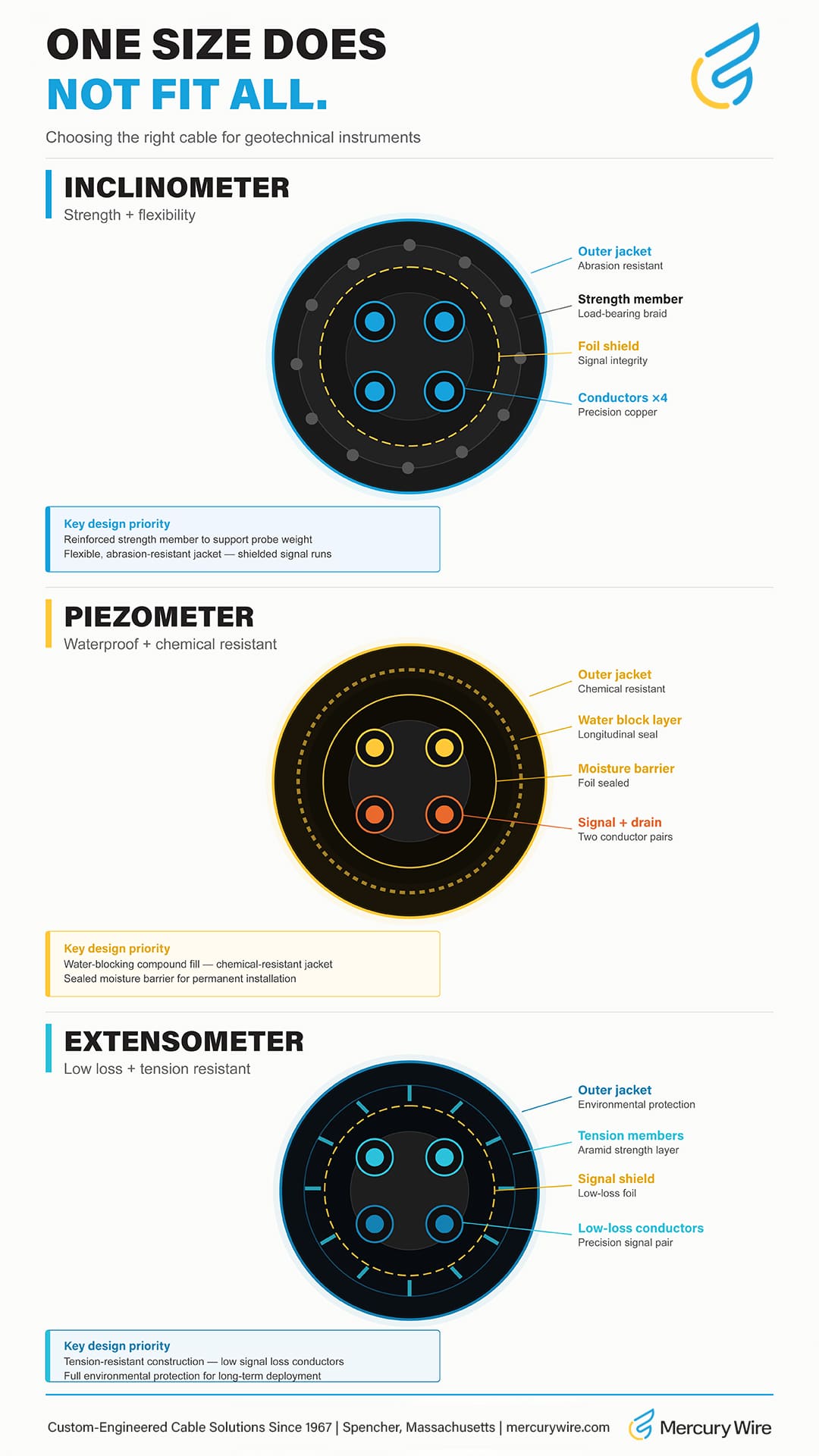
Inclinometers are used to measure lateral movement in soil, rock, and retaining structures. They’re commonly installed in boreholes to track ground displacement over time, which is critical for monitoring slopes, embankments, dams, and excavation sites.
Because inclinometer systems often operate in deep installations, inclinometer cable design must address several key challenges.
Mechanical Strength
Cables may need to support the weight of probes and withstand repeated insertion and removal during readings. Reinforced conductors or strength members are often required to prevent stretching or breakage.
Flexibility
Despite the need for strength, inclinometer cables also need flexibility. They must move smoothly through casing grooves and bend without damaging the internal conductors.
Abrasion Resistance
Repeated probe movement inside casing can cause friction. Durable jacket materials help protect the cable against abrasion and wear.
Signal Stability
Long cable runs can introduce electrical noise. Proper shielding and conductor selection help maintain accurate readings, even at depth.
A well-engineered inclinometer cable balances durability with flexibility, ensuring reliable operation during both installation and long-term monitoring.
Piezometer Cable Requirements: Protecting Signals in Wet Environments
Piezometers measure pore water pressure within soil or rock. Because they’re typically installed below the groundwater table, their cables operate in constantly wet—and sometimes chemically aggressive—environments. This makes piezometer cable requirements especially demanding.
Waterproof Construction
Moisture ingress is one of the biggest threats to piezometer systems. Even a small leak can compromise signals or cause sensor failure.
High-quality piezometer cables use:
- Moisture-resistant insulation
- Sealed jacket designs
These features prevent water from traveling along the cable and damaging the sensor.
Chemical Resistance
Groundwater environments can contain salts, acids, or industrial contaminants. Cable jackets must resist chemical degradation to maintain long-term reliability.
Materials such as polyurethane or specialized PVC compounds are often used to provide protection in aggressive environments.
Signal Integrity
Piezometer signals can be very small and sensitive. Proper conductor design and shielding are essential to prevent electrical interference that could distort readings.
Long-Term Durability
Unlike some monitoring systems, piezometers are often installed permanently. That means their cables must perform reliably underground for many years without maintenance.
Meeting piezometer cable requirements includes durability, as well as protecting the accuracy of critical groundwater data.
Extensometer Cable Considerations: Supporting Precision Measurement
Extensometers measure vertical or horizontal displacement between fixed points in soil or rock. They’re commonly used in tunnels, dams, foundations, and mining operations to monitor structural movement.
Because extensometers track extremely small changes in position, their cables must support high-precision data transmission.
Low Signal Loss
Some extensometers rely on sensitive measurement techniques that require stable electrical signals. High-quality conductors and shielding help minimize signal degradation over long distances.
Tension Resistance
Extensometer cables may experience tension as the monitored structure moves or settles. Reinforced construction helps prevent stretching that could affect measurement accuracy.
Environmental Protection
Like other geotechnical instruments, extensometers are frequently installed in harsh environments. Cable jackets must resist moisture, abrasion, and temperature fluctuations.
Installation Reliability
Extensometer installations can be complex. Cables need to be easy to handle, route, and terminate without risking damage during deployment.
Thoughtful cable design helps ensure extensometer systems deliver the precise measurements engineers depend on.
Key Factors in Effective Geotechnical Sensor Cabling
Although each instrument has unique requirements, successful geotechnical sensor cabling typically includes several common design considerations.
1. Environmental Protection
Cables must withstand moisture, chemicals, UV exposure, and extreme temperatures depending on the installation environment.
2. Mechanical Strength
Installations often involve deep boreholes, heavy sensors, or repeated movement. Reinforced cable construction helps prevent failure.
3. Electrical Performance
Proper conductor sizing, shielding, and insulation are essential for maintaining signal accuracy.
4. Long-Term Reliability
Many geotechnical monitoring systems are designed to operate for years or decades. Cable materials and construction must support this extended lifespan.
5. Customization for the Application
Because monitoring systems vary widely, engineered cable designs often provide the best performance and durability.
Why Custom Cable Design Makes the Difference
Off-the-shelf cables rarely account for the full range of environmental, mechanical, and electrical demands found in geotechnical monitoring projects. That’s why many engineers choose custom cable solutions.
At Mercury Wire, we work closely with OEMs, instrumentation manufacturers, and engineering firms to develop cables tailored to specific sensor systems and installation environments.
This collaborative approach allows us to optimize:
- Shielding configurations
- Jacket materials
- Waterproofing methods
- Strength members for load support
The result is a cable solution designed specifically for the performance needs of the instrument.
Supporting Reliable Monitoring from the Ground Up
Geotechnical sensors play a critical role in protecting infrastructure, preventing landslides, and ensuring construction safety—and even the most advanced monitoring equipment depends on reliable connectivity.
Thoughtfully engineered inclinometer cable design, carefully considered piezometer cable requirements, and robust geotechnical sensor cabling are essential for maintaining data accuracy and system longevity.
When the right cable is matched to the right instrument, monitoring systems can deliver the dependable data engineers rely on to make informed decisions. And when it comes to critical geotechnical applications, reliability makes all the difference.
Why Choose Mercury Wire
Mercury Wire partners with you to engineer a solution that fits your sensors your site and your long term monitoring goals. Contact us today to learn more about custom geotechnical instrumentation cables, explore our FAQ page for technical insights, or request a quote to fast-track your next project.