Key Takeaways
- Environmental monitoring cable is one of the highest-failure-risk components in any field deployment, and when it fails the consequences extend well beyond the cable itself. Compromised data records, expensive maintenance trips to remote sites, and sensor replacements that never fix the actual problem.
- Standard cable fails in field monitoring environments for predictable reasons: UV exposure degrades jacket materials, moisture migrates through damaged jackets and distorts signal readings, temperature cycling stresses conductors and terminations, and chemical contact from soils and runoff attacks incompatible materials.
- Signal integrity depends on the right shielding strategy. Foil, braided, combination shields, and drain wires each address different noise sources, and the wrong choice produces readings that look like real measurement events but are not.
- Material selection is the highest-leverage design decision, with PVC, polyurethane, polyethylene, thermoplastic elastomers, and fluoropolymers each fitting specific exposure profiles. The right choice matches the actual installation conditions, not the least expensive option that does not immediately fail.
- Cable specification should be a system design decision made at the start of a project, not a procurement afterthought. The cost of a cable failure in the field almost always exceeds the cost of the cable itself many times over in maintenance, data loss, and regulatory exposure.
Environmental monitoring systems depend on accurate, uninterrupted data. The sensors, data loggers, and instrumentation that collect that data get most of the attention during system design. The cable connecting everything together usually doesn’t.
That’s a mistake. Environmental monitoring cable is one of the highest-failure-risk components in any field deployment, and when it fails, the consequences extend well beyond the cable itself. Sensors go offline. Data records develop gaps. Maintenance crews travel to remote sites to troubleshoot problems that a better cable specification would have prevented entirely.
This guide covers what environmental monitoring cable actually needs to do, what separates a well-specified cable from a generic one, and where cable design decisions have the greatest impact on system reliability and lifecycle cost.
What Environmental Monitoring Cable Actually Does
Every sensor in a field monitoring system depends on a cable to carry its signal back to a data logger, controller, or telemetry system. That cable also carries power in many configurations, and in multi-conductor designs it may support several sensors over a single run.
The challenge is that environmental monitoring systems operate in conditions that are genuinely hostile to standard cable construction. Submersion, UV exposure, freeze-thaw cycling, chemical contact, mechanical stress, and rodent activity are not edge cases in this application category. They are routine. Cable that isn’t designed for these conditions doesn’t fail occasionally. It fails predictably.
The applications where this matters most share one thing in common: cable failure is expensive, inconvenient, and often invisible until the data record is already compromised.
Groundwater Monitoring Wells
Sensors deployed hundreds of feet below grade measure water levels, pressure, conductivity, and contamination over years or decades. Cable must survive continuous submersion, variable groundwater chemistry, and the mechanical demands of deployment and retrieval through narrow wellheads.
Surface Water and Wastewater Systems
Monitoring stations near rivers, lakes, treatment facilities, and stormwater outfalls need cable that handles constant moisture exposure, sunlight, and mechanical wear, often in locations that see significant seasonal variation in water level and flow.
Remote Weather Stations
Weather station cables live outdoors year-round, exposed to UV, temperature extremes, moisture, and rodent activity. Maintenance access is infrequent and expensive, which means cable that degrades gradually creates data quality problems that are difficult to catch and costly to fix.
Pipeline Monitoring Systems
Pipeline monitoring cables span long distances across varied terrain, often buried for decades. EMI from industrial infrastructure, aggressive soil chemistry, and the impossibility of routine inspection make cable specification particularly consequential along these routes.
Industrial Environmental Compliance
Facilities monitoring emissions, runoff, or site contamination operate in environments with chemicals, machinery vibration, and demanding duty cycles. Cable needs to perform reliably around the same conditions it is there to help monitor.
Why Standard Cable Underperforms in Field Monitoring Environments
Standard commercial cable is designed for predictable, controlled environments. Conduit runs inside buildings. Short outdoor runs with periodic inspection access. Applications where replacement is straightforward and downtime is measured in hours rather than weeks.
Environmental monitoring installations don’t offer those conditions. A sensor deployed in a groundwater well may be hundreds of feet below grade with no practical access for years. A weather station cable on a remote agricultural site may not be inspected between growing seasons. A pipeline monitoring run may cross miles of varied terrain, buried under soils with different chemical profiles and moisture levels throughout.
In these settings, standard cable fails for predictable reasons. UV exposure degrades jacket materials and causes cracking. Moisture intrudes through jacket damage and migrates along the cable core, degrading insulation resistance and distorting signal readings. Temperature cycling causes expansion and contraction that stresses conductors and terminations over time. Chemical contact from soils, agricultural runoff, or industrial contamination attacks incompatible jacket and insulation materials.
None of these failure modes announce themselves clearly. Data quality degrades gradually and readings drift. By the time the problem is identified, the consequences typically include:
- Months of compromised records that may need to be discarded
- Maintenance crews traveling to remote sites that were chosen for their remoteness
- Sensor replacement costs when the actual problem was the cable all along
- Regulatory or reporting complications from data gaps during critical monitoring periods
- Full retrieval and reinstallation of buried or submerged equipment
- Returns to the sensor manufacturer for root cause analysis and investigation, adding cost, project delays, and reputational risk at the customer level before the cable is ever identified as the source of the problem.
Key Design Considerations for Environmental Monitoring Cable
No single cable construction works across all environmental monitoring applications. The right specification depends on the installation environment, the sensor types involved, the signal characteristics, and the expected service life. These are the design factors that matter most.
Moisture and Water Resistance
Wet conditions are the most common cable killer in environmental monitoring. That includes direct submersion in groundwater wells and surface water installations, condensation inside junction boxes, coastal salt spray, and flood-prone sites where cables may be periodically inundated.
Water-blocking construction uses gels, tapes, or swellable materials to prevent moisture from migrating along the cable core if the jacket is damaged. This is particularly important in buried or submerged applications where jacket inspection isn’t practical. A nick during installation should not become a sensor failure two years later.
UV and Weather Resistance
Outdoor cable that isn’t rated for UV exposure has a limited service life that shortens significantly in high-sun environments. Jacket materials degrade, crack, and become brittle. Once the jacket is compromised, moisture and mechanical damage follow quickly.
UV-resistant jacket materials extend outdoor cable life substantially. For installations in extreme climates, material selection also needs to account for low-temperature flexibility to prevent cracking during winter handling and installation.
Chemical Resistance
Soils and water at environmental monitoring sites are rarely chemically neutral. Agricultural sites carry fertilizers, pesticides, and irrigation chemistry. Industrial sites may have hydrocarbon contamination, cleaning agents, or process chemicals in the soil. Even natural groundwater chemistry varies significantly in ways that affect cable material performance over time.
Jacket and insulation materials need to be matched to the anticipated chemical environment of the specific installation, not selected generically.
Signal Integrity
Many environmental monitoring sensors produce low-voltage analog signals. These signals are vulnerable to electrical noise from nearby sources including:
- Power lines
- Pumps and motors
- Radio transmitters
- Lightning activity
- Industrial electrical infrastructure
Without proper shielding, that noise can look like a real measurement event. Signal distortion that represents a fraction of a percent of a signal range produces readings that are wrong in ways that are difficult to catch without redundant instrumentation.
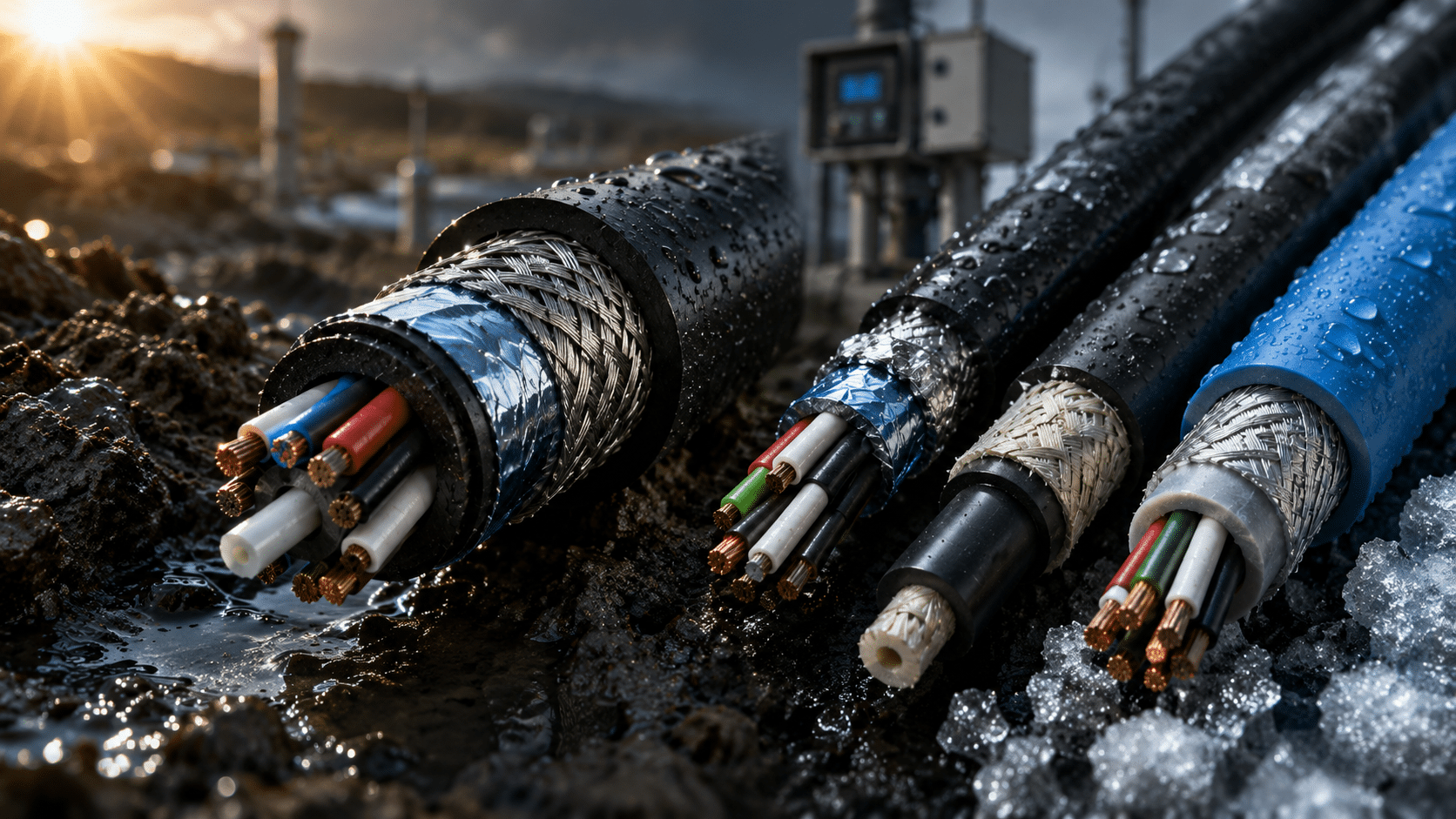
Proper shielding, twisted-pair construction, controlled impedance, and conductor sizing for the actual run length all affect whether the signal arriving at the data logger accurately represents what the sensor measured. Depending on the noise environment and signal type, cable designs for environmental monitoring may incorporate:
- Foil shielding for lightweight, full-coverage protection
- Braided shielding for higher flex life and greater coverage in mechanically demanding installations
- Combination foil and braid for maximum noise rejection in high-interference environments
- Drain wires for reliable grounding continuity along the cable run
Selecting the right shielding configuration for the specific noise environment is one of the most consequential design decisions in environmental monitoring cable specification.
Flexibility and Mechanical Durability
Some environmental monitoring installations involve equipment that is deployed and retrieved repeatedly. Groundwater probes are pulled from wells for maintenance. Portable monitoring equipment is moved between sites. Cables in these applications need construction that tolerates repeated bending and handling without conductor or insulation damage.
Even in fixed installations, cables experience mechanical stress from soil movement, thermal cycling, and installation tension. Construction that accounts for these stresses lasts longer and fails less unpredictably than construction that doesn’t.
Temperature Performance
Environmental monitoring sites often see significant temperature ranges across seasons and even across a single day. Cable materials need to remain electrically stable and physically intact across the full operating temperature range of the installation, not just at the midpoint.
Common Materials Used in Environmental Monitoring Cable
Material selection is one of the highest-leverage decisions in cable design for environmental monitoring. The right choice depends on the combination of environmental exposures the cable will face.
| Material | Key strengths | Best fit |
|---|---|---|
| PVC | Economical and versatile with moderate environmental resistance | General-purpose runs; can turn brittle in extreme cold and struggles with aggressive chemicals |
| Polyurethane | Strong abrasion resistance and flexibility across a wide temperature range | Installations with repeated handling and mechanical stress |
| Polyethylene and cross-linked polyethylene | Good moisture resistance and stable electrical properties | Buried and submersible applications |
| Thermoplastic elastomers | Flexibility and environmental resistance with good durability and handleability | Applications needing both durability and easy handling |
| Fluoropolymers | Highest performance in demanding chemical or high-temperature environments | Used when no other material meets the combined requirements, at higher cost |
Each material involves tradeoffs across cost, flexibility, chemical resistance, temperature range, and regulatory requirements. The right choice is the one that fits the actual installation conditions, not the least expensive option that doesn’t immediately fail.
Where Cable Specification Has the Greatest Impact
Three environmental monitoring applications illustrate how cable design choices translate directly into system performance and lifecycle cost.
Groundwater Monitoring Wells
Groundwater monitoring cables operate in some of the most demanding conditions in environmental sensing. Continuous submersion, hydrostatic pressure at depth, variable water chemistry, and the mechanical demands of deployment and retrieval through narrow wellheads all place requirements on cable construction that standard products aren’t designed to meet.
The consequences of cable failure in a groundwater well are particularly severe. Retrieval and reinstallation of a well sensor is expensive and time-consuming. Data gaps during critical monitoring periods may have regulatory implications. In programs tracking aquifer health or contamination over years or decades, a cable failure can compromise the entire data record.
We’ve covered groundwater monitoring cable requirements in detail in our post on engineered cable for groundwater monitoring systems. If your application involves submersible sensor deployments, that’s the place to go deeper.
Remote Weather Stations
Remote weather stations face a specific combination of challenges: UV exposure, wide temperature cycling, moisture, rodent activity, and the practical reality that maintenance access is expensive and infrequent. Cable that degrades gradually in these conditions produces data quality problems that are difficult to attribute correctly. Field crews replace sensors when the real problem is the cable carrying the signal.
UV-resistant jacket materials, appropriate shielding for the local noise environment, and construction that tolerates freeze-thaw cycling extend weather station cable life substantially and protect the integrity of the data the station produces.
Our post on custom cable for remote weather stations covers the design considerations specific to atmospheric sensing networks.
Pipeline Monitoring Systems
Pipeline monitoring cables span long distances across varied terrain, often buried in soils with different chemical profiles and moisture levels across the route. EMI from industrial infrastructure, mechanical stress from soil movement and installation, and the practical impossibility of inspecting buried cable regularly all make cable specification particularly consequential.
Direct burial performance, chemical resistance matched to the soil and product environment, armoring options for mechanically demanding installations, and low-capacitance design for long-distance signal integrity are the priorities that differentiate well-specified pipeline monitoring cable from generic alternatives.
Our post on rugged cable for pipeline monitoring systems covers the design priorities specific to buried pipeline infrastructure.